

In February 1915, Arthur D. Little told the Chamber of Commerce of the United States that America should not build a synthetic dye industry.
He was the most respected consulting chemist in the country. His argument was arithmetic. Even if American producers took every pound of domestic demand, he said, it “would amount to only about $10,000,000 annually, a little more than the candy sold by the Woolworth stores.” Why, he asked, “should we duplicate them only to plunge into an industrial warfare against the most strongly fortified industrial position in the world?”
Five years later the Senate Finance Committee answered him without meaning to. American dye consumption ran about twenty-five million dollars a year, the committee reported, “but these dyes were absolutely necessary in industries producing $3,000,000,000 worth of goods annually.” In the early war years, it added, “400,000 people might have been put out of work for want of dyestuffs.”
Little had the market size right. He had the question wrong.
The short version, for anyone who wants it before the story. In 1913 the United States made 1.8 percent of the world’s dyes. Germany supplied roughly nine tenths. In 1919 Washington seized more than 4,500 German chemical patents and sold them to an industry-owned foundation for $271,850. Only 699 were ever licensed, and the lift in American invention took over eight years to appear. The synthetic rubber program took 41 months from first proposal to production at scale; individual plants took 9 months. Today, the Defense Department has published two lists of chemicals the country cannot make, 22 in 2022 and 28 in 2024, with no purchase commitment behind either. Qualifying a second source for an existing energetic material takes 18 to 24 months. A new material in a fielded system takes three to five years. The Defense Production Act authority funding most of this expires September 30, 2026.
I went back and read those documents because of a number from last summer.
What Washington paid for a rare earth
In July 2025, the Defense Department put a floor of $110 per kg under MP Materials’ neodymium praseodymium oxide for 10 years, paying the difference whenever the market falls short. $400 million in preferred equity, a warrant that together with the preferred comes to 15% of the company, a 100% offtake on one new magnet plant’s output, and a guaranteed floor of $140 million a year in EBITDA.
Call it a subsidy, but what makes it unusual is the direction things moved: price and volume risk onto the federal balance sheet, equity coming back the other way. That is closer to project finance than to a grant.
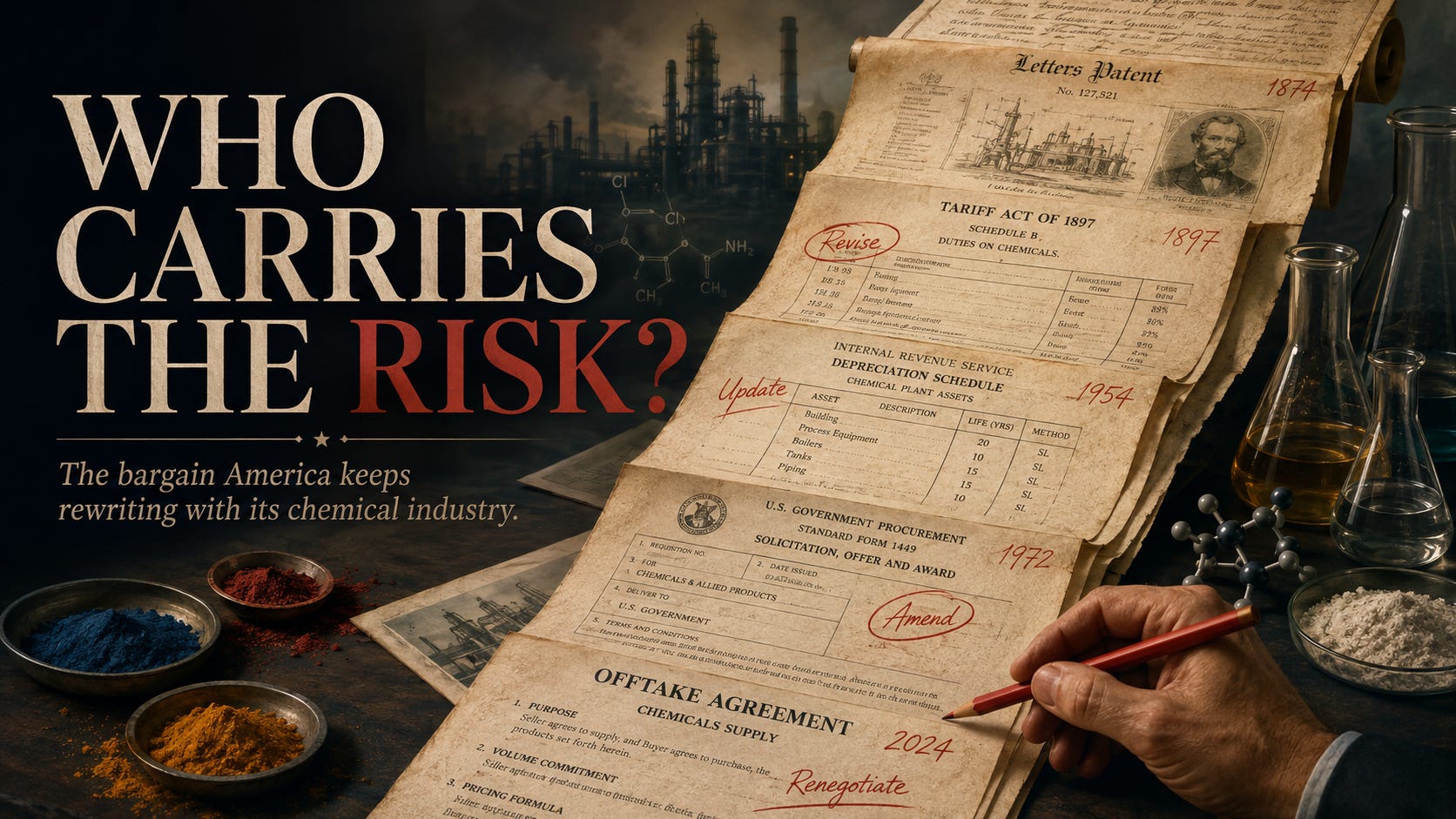
Which is the only question that has ever really been at issue here. Not whether the country wants the chemistry. Who carries the risk (and benefit) of making it.
Washington has done versions of this before, and the last serious one is worth remembering. The Synthetic Fuels Corporation guaranteed prices and engineered offtake for synthetic natural gas in the early 1980s, hundreds of millions of dollars of it. Congress abolished the corporation in 1986, when energy prices came back. A ten-year floor is only as good as the politics underneath it.
So: how often has this happened, and what did it actually buy?
The patents did not work
By 1913, the United States made 1.8 percent of the world’s dyes, and American “manufacturers” were mostly assembling German intermediates shipped in. When the blockade closed, sulfur black went from twenty cents a pound to as much as three dollars inside a year.
Washington seized more than 4,500 German chemical patents under the Trading with the Enemy Act and sold them to an industry-owned entity, the Chemical Foundation, for $271,850. Francis Garvan, the Alien Property Custodian, told the National Cotton Manufacturers’ Association why it mattered: “Useless your armies and your navies, your U-boats and your aeroplanes, unless by means of a developed dye industry you keep abreast with modern chemical warfare.”
Then, in the same 1919 volume making the case for the seizure, A. Mitchell Palmer wrote this about what had been taken: “The price thus paid was necessarily determined somewhat arbitrarily; the great majority of the patents were presumably valueless.”
He was right, and it has since been measured. Of the 4,500-plus patents, 699 were ever licensed, to 326 firms. Royalties came to nearly $700k. There was a real lift in American chemical invention, roughly 20 percent, but it does not show up until 1927 and the full effect does not arrive until about 1932.
Over eight years later…
The buyer at the 1918 Bayer auction paid $5.3 million for all the legal rights and then went back to Germany to buy the know-how. DuPont held the seized patents and at the same time paid four German chemists $25,000 a year to come to Delaware. The patents were a map and nobody was short of maps.
Every chemical factory is a potential arsenal
Three separate 1919 sources converged on the same metaphor, independently. That convergence is the evidence.
Maj. Gen. William L. Sibert, Director of the U.S. Chemical Warfare Service, before the Senate Finance Committee in December 1919: “I have been very much impressed during the war by a statement which I read somewhere that every great chemical industry was a potential arsenal.”
An Allied Governments commission report, read aloud by Garvan: “In the future it is clear that every chemical factory must be regarded as a potential arsenal, and other nations cannot, therefore, submit to the domination of certain sections of chemical industry.”
A. Mitchell Palmer, on why the adjacency was technical, not rhetorical: “In the production of sulphur black, one of the most important black dyes, a slight variation in the final step of the long and complicated process of manufacture will transform the ultimate product into picric acid. More important still, however, is the fact that the technical skill required for the manufacture of explosives is precisely that possessed by the chemical staff of a successful dye works and is to be found nowhere else.”
None of those three had read the others. They arrived at the same sentence because the physics of the plant makes it true. A dye works and a munitions works are the same building with a different reagent in the last vessel.
That is the argument for caring about the $25 million dollar business that gates the $3 billion market. It was true in 1919. It is true now, at a different scale, for a different set of molecules.
The chemistry was never the slow part
The synthetic rubber program is one everyone cites, and the primary documents are better than the legend.
The Baruch committee was honest about the ask in September 1942. Having lost most of the natural rubber supply, “we must have created, within two years after Pearl Harbor, one of the largest industries in the country. Normally such a development would require a dozen years.”
They mostly did it, with rationing and reclaimed rubber covering the gap. Fifty-one plants, government-owned, one customer. An antitrust exemption twelve days after Pearl Harbor so the oil and rubber companies could pool patents. And one recipe, mandated in March 1942, so every plant made the same GR-S and the plant designs became interchangeable.
The timeline is the interesting part. Standard Oil proposed the program in November 1939. Jesse Jones at the RFC cut it, then cancelled it outright in February 1941. First petroleum butadiene plant online April 1943.
41 months! Individual plants, once someone decided, went up in 9. The committee watched it happening and said so: “Delay on the part of the Government can turn this ‘quick butadiene’ into slow butadiene.”
One molecule, one recipe, hundreds of thousands of tons. Standardization was possible because the volume was enormous and the target was singular. Today’s list[s] run to dozens of molecules at hundreds of tons each, with no common process.
What we did next
For 40 years, Cold War procurement was one of several things sustaining small-batch synthesis in the United States. Then we stopped paying for it, and the government has been honest about it. The National Energetics Plan says that over the past forty years “DoD has eliminated, or greatly reduced, the required sustainment funding for Government-owned facilities,” and that they “continue to deteriorate and degrade.” Single-source suppliers are “alarmingly high,” usually buried “three to seven layers deep.”
Be precise about what actually left, because the decline story is mostly wrong. American chemical manufacturing grew: shipments up 22.4 percent between 2017 and 2022, on cheap ethane. What went was batch, multipurpose, small-volume, high-hazard synthesis. Hundreds of ton, not hundreds of kilotons, and it left for compliance cost and Asian cost structure at least as much as for any withdrawn defense premium.
Small but critical chemistries again. Little’s problem, 90 years on…
Six ways to answer the question
Every instrument Washington has used on chemistry is really an answer to who carries what.
Transfer the IP — Chemical Foundation, 1919. Risk: Industry, entirely. Result: Partly, eight to nine years later.
Raise a tariff — Coal-tar duties, 1922 to 1980. Risk: The customer. Result: Volume yes, capability no.
Accelerate the write-off — Certificates of Necessity, 1950 to 1955. Risk: Industry, with the timing shared. Result: Yes, on private balance sheets.
Buy the output — Rubber Reserve, 1942. Risk: Government, almost all of it. Result: Yes.
Own the plant — GOCO ordnance plants. Risk: Government, all of it. Result: Yes, and no exit.
Floor the price, take the equity — MP Materials, 2025. Risk: Government carries price and volume; industry keeps ownership minus a 15 percent stake. Result: Too early to say.
The first two are cheap to legislate and cost nothing up front, which is why they get reached for. The third is the one nobody talks about and the only one that left no disposal problem behind. The sixth is what we are running now, and it has no historical comparable.
Which brings me back to $110
The lists exist. A 2022 Defense Production Act call named 22 defense-critical chemicals, from potassium perchlorate to sebacic acid. A 2024 solicitation names 28 more. [Somebody] has done the work of figuring out what we cannot make.
Neither list carries a volume, a price, or a named buyer. Awards run one to $24 million against plants that historically cost a hundred million, and the governing language tells applicants everything is “subject to the availability of future Government funding.”
Meanwhile the clock runs. GAO looked at the nuclear explosives supply chains in March and described the process for qualifying a new supplier as one that “often begins after the current supplier fails to provide material.” Chris Kubasik at L3Harris made the point from the industry side: a third or fourth solid rocket motor provider would just call the same sub-tier suppliers “that we already have locked up,” and “have to get to the back of the line.” Money entering at the platform level cannot pull through a chemical nobody is qualified to make.
Qualification is the asset
That sentence is most of the diligence.
Eighteen to twenty-four months for a second source. Three to five years for a new material in a fielded system. A qualified line is a moat you cannot buy your way past, and revenue reading “subject to the availability of future Government funding” does not finance the way a ten-year floor does. If you are underwriting in this space, those two facts do more work than any market map.
An obvious answer, and why it is harder than it looks
The obvious answer is that industry should organize itself. One front door, a coordinated slate of makers, something handed to Washington already assembled rather than waiting to be assembled by it.
That has been tried, and versions of it are running now. The National Armaments Consortium has covered defense energetics since 2002 and has more than a thousand members. The Defense Industrial Base Consortium, stood up in 2024, lists critical chemicals as one of its sectors and issued the very solicitation I quoted above. Last year the Energy Department went further and built an actual producer consortium in the nuclear fuel cycle under Section 708 of the Defense Production Act, the provision that gives competitors an antitrust defense when they coordinate on capacity. Justice signed off in April.
So the machinery exists. What has not been tried is the version where the producers start it. Every one of those bodies was chartered by the government, and Section 708 is part of the reason: the antitrust shelter requires a federal sponsor, an Attorney General sign-off, and a government employee in the room. The one clean path to industry organizing itself runs through Washington.
Which brings me back to 1919, uncomfortably. The Chemical Foundation was an industry-owned entity, chartered to build domestic capability, holding pooled technology behind one door. What it mostly became was a licensing desk and a tariff lobby. It did produce something real, eight years late. Nobody who set it up would have described that as the plan.
I do not think that means the intention is wrong. I think it means the intention only works when somebody is accountable for a specific molecule reaching qualified-source status on a specific date, and when the money behind it outlasts an appropriation cycle. Neither is true today for a single chemical on any list.
Arthur Little was right that the dye business was small. He was wrong that small meant unimportant, and it took a blockade to settle the argument. The lists we have now are a cheaper way to learn the same thing, if anyone reads them as a bill of materials rather than a wish list.
The bargain gets rewritten every time. Patents in 1919, tariffs in 1922, government-owned plants in 1942, a price floor in 2025. What does not change is the question underneath, and right now the answer for a defense chemical is that a company with under a hundred million in revenue carries almost all of it.
Who carries the risk (and gets the benefit)?
If you are underwriting in this space, two sentences of qualification language are most of your diligence. And if you have seen someone build the version that works, or try and fail, I would like to hear about it.
Sources: Arthur D. Little, “The Dyestuff Situation and Its Lesson,” address to the Chamber of Commerce of the United States, February 5, 1915. Senate Report 66-425, February 1920. “Aims and Purposes of the Chemical Foundation,” 1919. Senate Finance Committee, Dyestuffs hearings, December 8, 1919. Moser and Voena, “Compulsory Licensing: Evidence from the Trading with the Enemy Act,” American Economic Review, 2012. Report of the Rubber Survey Committee, September 10, 1942. National Energetics Plan, OUSD(R&E), May 2023. GAO-25-107016, March 2025. U.S. Census Bureau. MP Materials company disclosure, July 2025.