

A custom chemistry plant is worth more than its reactors when it holds a permitted capability, the skill to run it, and a qualified customer that a buyer can’t rebuild in a year. This Field Guide sorts the US makers by that skill: nine kinds of hard chemistry, read through the three buyers that share the same reactors (pharma, industrial tech, and agro). End markets drive demand, but those three things set the price.
I’ve spent a lot of my working life around plants like these, and I kept noticing that buyers don’t pay for them the same way. So I started writing down why. This is that notebook, built from permits, filings, releases, and the deal tape, current as of October 2026. Where a number is soft, I say so. I might be wrong on any call in here, and I’d like to hear where.
Why I sort custom chemistry makers by skill
From the outside, fine chemistry, pharma contract manufacturing (CDMOs), and toll plants look like one market. They share reactors, chemists, and vocabulary. But one plant sells into several end markets, so the end market can’t tell two plants apart.
So I sort plants by the chemistry they’re permitted and equipped to run. If you’re valuing or selling a plant, compare it with plants that run the same chemistry, not plants that serve the same customer. End markets tell you where demand is heading. The skill and the permitted capability behind it tell you what a buyer will pay for the site.
One piece of good feedback I’ve received on this so far: permits are a good way to segment the market, but once you’re underneath them, assessing the capabilities of the team is a key area of further diligence, and probably where the long-term defensibility sits. I agree. The public record can tell you who holds the permit. It can’t tell you how capable the people running the chemistry are, so this guide is a starting point for that work, not the end of it.
The nine skills, and what’s scarce in each
1. Fluorine and halogens. The scarce thing is HF, F2 and SF4 handling. Eight named US makers, and none offers HF at custom scale. The money so far is capex, with no disclosed site sale.
2. Organometallics and reactive metals. Pyrophoric, air-free work. The one nearby multiple is seller-stated: Honeywell paid 13.3x for Johnson Matthey’s catalyst business.
3. Silicon chemistry. Chlorosilanes and hydrosilylation. Fab precursors are up and basic siloxanes are down, and there’s little independent left to buy.
4. High pressure, hydrogenation, alkoxylation. Pressure, hydrogen and ethylene oxide permits. One US independent went to an Indian platform in May 2025.
5. Specialty polymers, monomers, and CASE. Monomer chemistry and qualification. The one stated multiple is H.B. Fuller’s, under 6x after synergies for adhesive formulators.
6. Hazardous chemistry. Nitration, phosgene, cyanide and energetics. Orica paid $640m for Cyanco at 7.5x, buyer-stated.
7. High-purity inorganics and reagents. Parts-per-trillion purity and analytical grades. Fujifilm paid $700m for Entegris’s fab acids, while research catalogs are flat.
8. Licensed handling. DEA registration, containment and isotopes. Siegfried paid “below 10x” for Noramco’s US sites, its words.
9. Modality synthesis. Solid-phase synthesis and purification for peptides and oligos. Samsung Biologics offered CHF 44.31 a share for PolyPeptide, with no multiple stated. The offer was declared successful on October 16, 2026, and closing still waits on regulators.
My ranking: where the evidence and the deal record point
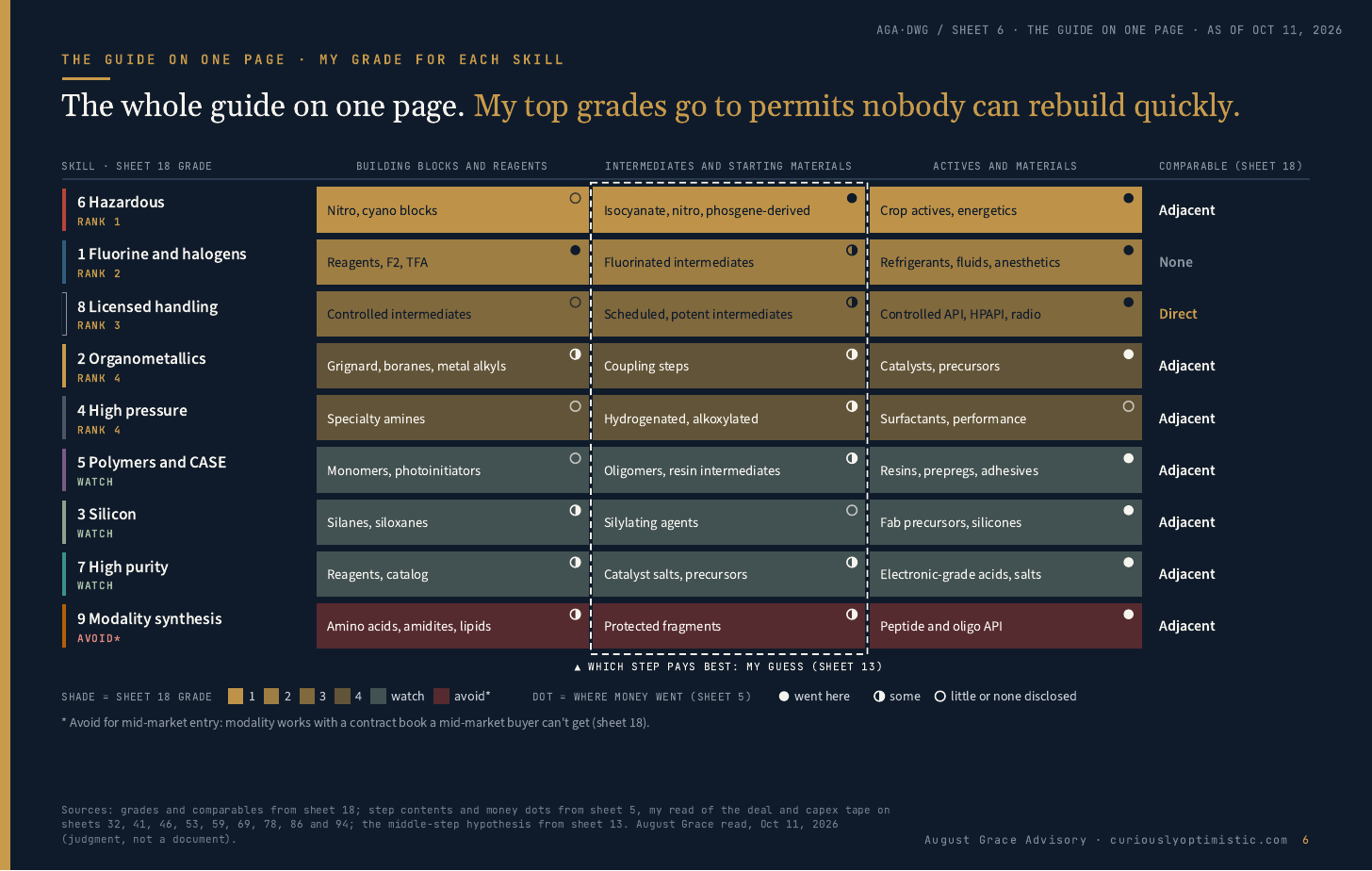
The capability and the qualified customer earn the premium, not the reactors. Here’s how I’d rank the nine for a buyer, and the comparable behind each call.
Pick 1: a US hazardous-chemistry site with a live, permitted capability. Nitration, phosgene, cyanide, energetics. The comparables are adjacent: Orica’s 7.5x for Cyanco and NewMarket’s ~$700m for AMPAC. The risk case: one permitted US site filed a WARN notice in March 2026 and then sold at an undisclosed price. The permit outlived the business that held it.
Pick 2: a Western fluorination or fluorine-reagent site. No site sale has printed a price yet. The evidence is capex, and Indian HF could undercut the US reagent step before a first comp prints.
Pick 3: DEA-registered or high-containment capacity in the US. This is the one direct comparable: Siegfried’s “below 10x” for Noramco’s US sites.
Tied fourth: organometallics and high-pressure independents with Western customers. Grace stated 9.5x for Albemarle’s fine chemistry sites. The independents sold at undisclosed prices.
Watch: silicon, polymers and CASE, and high purity. Almost nothing independent is left in silicon, and I found no sale of a US monomer or photoinitiator house. There’s likely better opportunity downstream, in application and formulation.
Avoid for mid-market entry: peptide or oligo capacity without a contract book. With a contract book the economics work (Bachem’s FY2025 EBITDA margin was 30.9%). A mid-market buyer can’t get that book.
Pass: capacity sold mainly on reactor time, with no permitted capability or qualified customer behind it. EUROAPI sold its Brindisi plant at €5m of enterprise value.
Ten years of deals, and only ten stated multiples
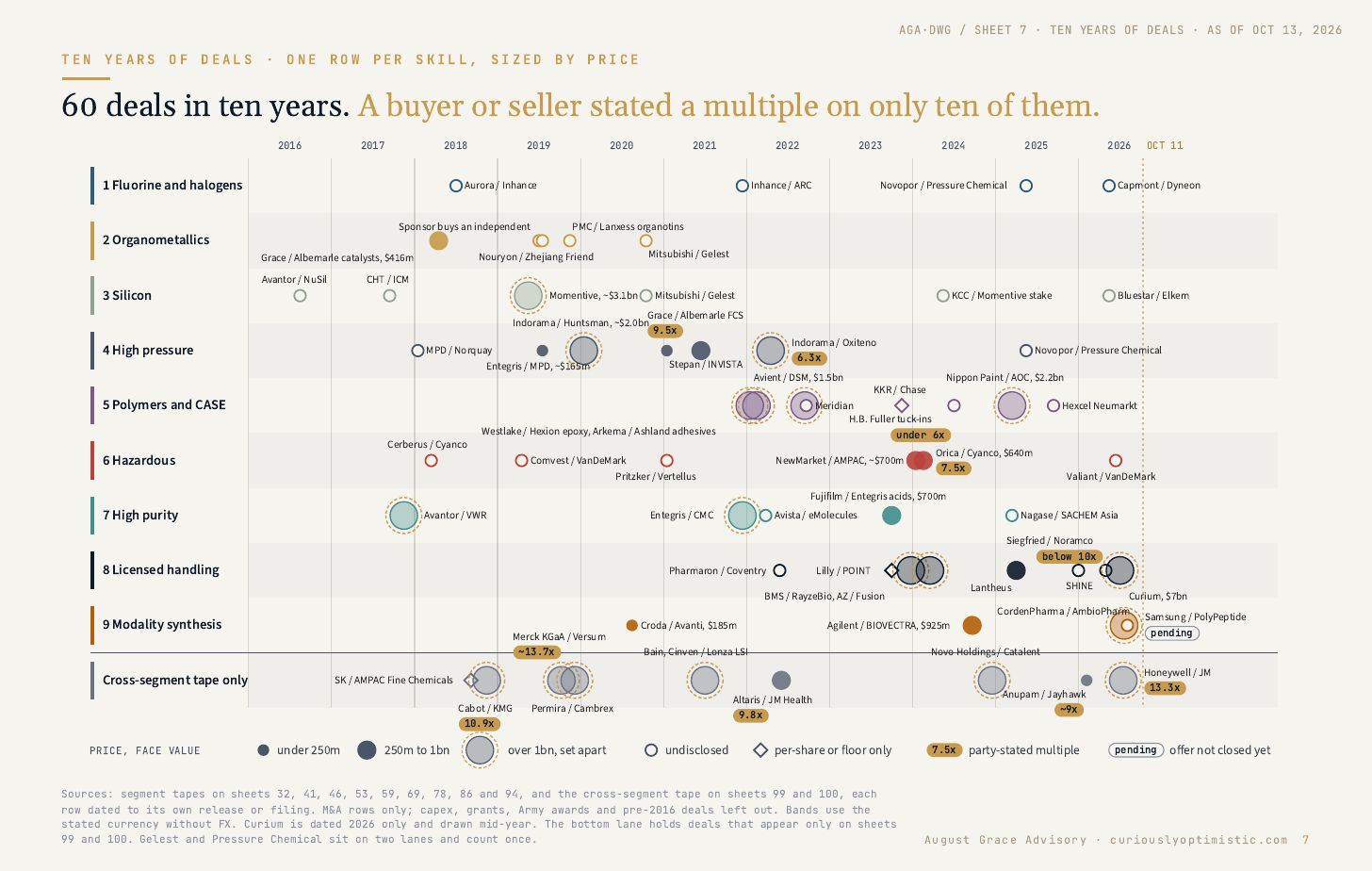
I logged 60 deals across the nine skills from 2016 to 2026. A buyer or seller stated a multiple on only ten of them, and I print a multiple only where a party to the deal stated it, with who said it. The smallest US multipurpose-site print was about $134m of enterprise value on about $78m of 2024 revenue and about $15m of EBITDA. That’s about 1.7x revenue (my arithmetic on the buyer’s figures) and about 9x EBITDA (the buyer’s figure). It’s one deal, so I wouldn’t build a range on it.
Where the profit is
Where a listed company breaks out a skill, the capability-heavy work shows the best margins. Dottikon’s hazardous chemistry printed a 34.6% EBITDA margin and Chemours’ refrigerants and fluids 32%, against 5.8% core EBITDA at EUROAPI’s generic API business and 4.0% operating margin at Stepan Surfactants. These aren’t like for like, since group and segment margins blend businesses. The pattern holds anyway. No US independent publishes a margin, so the private middle has to be read from the deals and the permits.
What’s in the full guide
The full guide runs 114 sheets plus a source appendix. Each of the nine segments runs in the same order: opener, size, why it earns more, how they get paid, who plays, deals, what to watch, and my call. Then the back matter: every deal under and over $1bn on one tape, what I’d do by reader (sponsor, owner, banker), the dates between now and next spring that would change my mind, the method, a glossary, and a source ledger with every number dated and linked.
The preview below is ten sheets of the full guide, free to download, and every sheet number matches.
Or explore the preview as an interactive guide (free): field-guide.augustgraceadvisory.com/custom-chemistry-makers-preview
