


I’ve sat in a lot of planning sessions where everyone could tell you what customers said they wanted, and almost nobody could show you which of those things decides whether a customer stays. A recent HBR IdeaCast episode put a name on that gap.
Vikas Mittal, a marketing professor at Rice University’s Jones Graduate School of Business, says executives are “more or less always wrong” about what creates value for customers. He’s a co-author of the HBR article (November 1, 2026), with Alessandro Piazza, Sonam Singh, and Ashwin Malshe. The episode ran on November 10, 2026. In the vast majority of the companies he studied, and he stresses he doesn’t mean a bare 51%, the correlation between what executives ranked and what actually created value was zero or negative. April Dunford has a name for the competitor that fills that gap: the status quo.

They can tell you what they want
Executives are good at reporting what customers say they want. That’s a different thing. His line is this: “Customers can tell you what they want, but customers often cannot tell you what they value.”
The example he uses is an apartment building. Ask residents what they’d want, and a lot of them say a gym. In his telling, fewer than 20% use it. What creates more value, he says, is the unglamorous work of fixing what’s broken.
Listening is for the list, not the rank-order
You should still talk to customers. That’s how you hear about the missed delivery. The mistake is building the company’s long-run strategy from those conversations. “Creating a strategy based on that that is going to guide your company for the long run is a mistake.”
Conversations get the variables onto the page: safety, price, quality, on-time delivery. The ranking is the job of evidence, not memory, and not the most senior person in the room. I have a hard time with the version of this that treats judgment as useless. Mittal doesn’t say that. He goes back to a 1979 paper by Robyn Dawes, and to the idea that intuition can have even more value “when it’s informed and bound by science.”
Salience is the culprit
Mittal names the cause: “salience is the culprit here.” Customers can tell you what is vivid, what just happened, what’s sitting on top of their mind. A lot of what creates value, he says, is small and routine. I see the same pattern in strategy rooms. Pretty soon the plan is a pile of salient things. At the front line, he says, people still do the little calculations. As you move higher, “it all becomes salience, hand waving, and so on and so forth.” If that’s even half right, the fix isn’t another offsite. It’s changing what a planning meeting is allowed to treat as evidence.
The competitor that isn’t on the slide
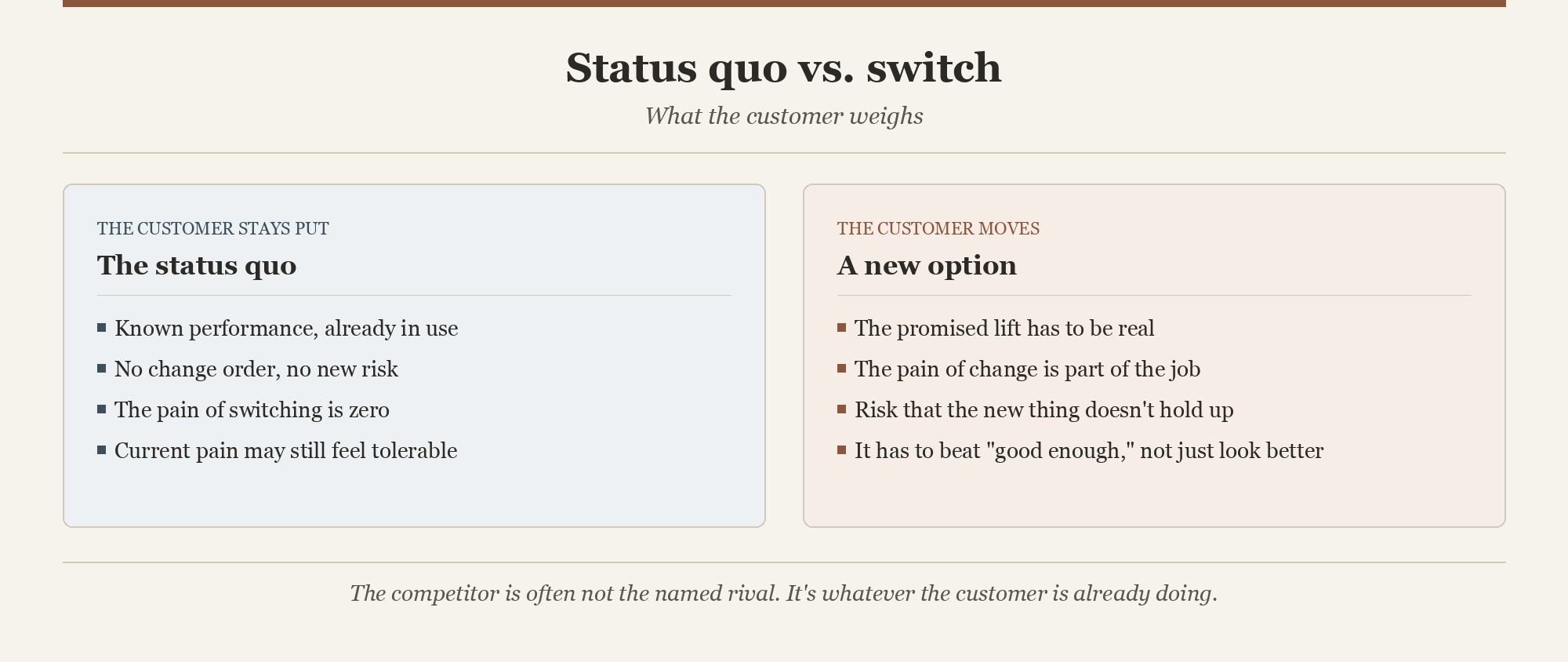
The competitor that matters is often not the named rival on the slide. It’s whatever the customer is already doing.
In her newsletter post A Buyer-Centric Approach to Competitive Positioning (November 14, 2023), Dunford writes that a B2B buyer can always “stick with what they already have,” and that “the current situation might be painful, but so is switching to something new.” Proving value is only the minimum bar. You also have to “reduce the pain of change.”
Sales teams, she says, often don’t even count that as competition. In a Best of B2B conversation with Dave Gerhardt, they “never count status quo as competition. They’ll say, oh, we lost no decision.”
In a March 10, 2026 piece for Lenny’s Newsletter, Dunford writes that “in B2B, vendors typically lose about half their sales opportunities to whatever the prospect is currently using,” and that she’s “worked with companies where that number exceeds 80%,” by her count from client work. About half the time, she says, a status quo decision “is more about customer indecision than a vote for the status quo solution,” pointing to Matt Dixon’s JOLT Effect research.
This is where Mittal and Dunford meet. Get the ranking wrong and you spend on the rival you can see, or on a new feature, and never touch the real competitor: a customer deciding change isn’t worth the trouble.
A day early did nothing. A day late did.
At one company Mittal worked with, delivering a day ahead of the intended date created no additional value. Being a day late created a substantial decrease in value. Early delivery was expensive for the company, so they stopped over-delivering and aimed for “on time to need date.” If the downside of a miss is much larger than the upside of a beat, the money goes to not missing it. The need date is tied to something real on the customer’s end. Beating it usually isn’t.
“All of the above” is not a strategy
So how can a leader tell a necessary strategic pivot from “organizational attention deficit”? Mittal’s answer is a change in mindset: “When you don’t know what to do, we just keep throwing things against the wall hoping something sticks. But when you know what to do, then you should slow down and become really excellent at it.”
HBR reports, in a published excerpt of the article, how rare that is. The authors describe a seven-year study of more than 70 companies, about 200 senior executives, and 24,000 customers. When employees were asked which item on a long menu (quality, service, price, and the rest) was the company’s priority, 96% said “all of the above.” Only 4% provided a rank ordering. When executives inside a given company ranked the drivers, fewer than 10% of their responses agreed.
Humility, and what to do with a favorite initiative
“The biggest impediment I have seen executives encounter is lack of humility,” Mittal says, “meaning starting from a place where you can imagine that you could be wrong.” He hears the same sentence a lot: I’ve been doing this for twenty years, we know what our customers want.
Adi Ignatius, host of HBR IdeaCast, asks what you do when the analysis says a powerful leader’s signature program adds little customer value. Mittal’s answer is not to walk in and kill it. The better conversation, he says, starts from the evidence: here’s something that creates even more value than your initiative, and we want you involved in it.
He points to Swagelok Southeast Texas, a Houston distributor the authors advised: a smart team that checked before spending. It was ready, he says, to put a great deal of money into warehouse automation. The analysis said the bigger driver for customers was rapid quoting. Quoting time was around 18 or 19 hours, and customers wanted same-day quotes. The CEO, he says, paused the automation work and pulled the chief operating officer into the quoting problem, work the COO could actually lead.

Even a very large customer’s request, he says, shouldn’t automatically override the broader drivers. In another example, the company educated its biggest customer first, then built that customer a custom quoting app because it served the driver that mattered.
Before the next leadership meeting
Ignatius asks, if an executive suspects the company is pursuing too many initiatives, what should happen at the next leadership meeting. Mittal doesn’t start with the meeting. “Before they have the next leadership meeting, they should think about identifying what are the one or two things that create the most lift in customer value? Having a real conversation about what are ways in which you can engage all the employees to do this. And the leadership meeting should really be about crystallizing that approach.”
When companies in his study “aligned their strategy to the customers and focused their employees to excel at it,” he says, financial performance improved.
When I open an offering memo, I go to orders and volumes first, then price. Can they move it when input costs move? Then I want to know why they win. What does the ingredient actually do inside the customer’s system, and do I think that’s worth something? I measure that at gross margin. When they lose, why do they lose? Who makes the buying decision? It may end up with procurement, but it needs to stay with the person who cares beyond the transaction. And then the Dunford question, from my side of the table: how easy is it to switch? Is it a repeat order, something that gets consumed, or a one-time capex buy?
In planning, I borrow an idea I’ve heard attributed to SpaceX. I’ve never seen it written down, so take it as a way of thinking. You write out the value chain, how you make what you make, and tag only the steps the customer actually pays for. Everything else is administration. It keeps the room honest about what creates lift and what’s just activity.
Next I’ll take this into chemicals and materials, where the status quo comes with a qualification nobody wants to reopen.