

Every night when I put my daughter to bed, she asks me the same question. There is usually a note of disappointment under the playful jest. “How much money did we make today, Dad?” She has appointed herself Head of Pipeline Oversight at August Grace. She is ten, going on eighteen.
She comes by the question honestly. A few weeks ago she taught me a parenting lesson about incentives I haven’t been able to shake, and I think it’s a useful perspective on whether AI is really cheating.
She arbitraged her own chore chart. I’ll explain.
The chore board
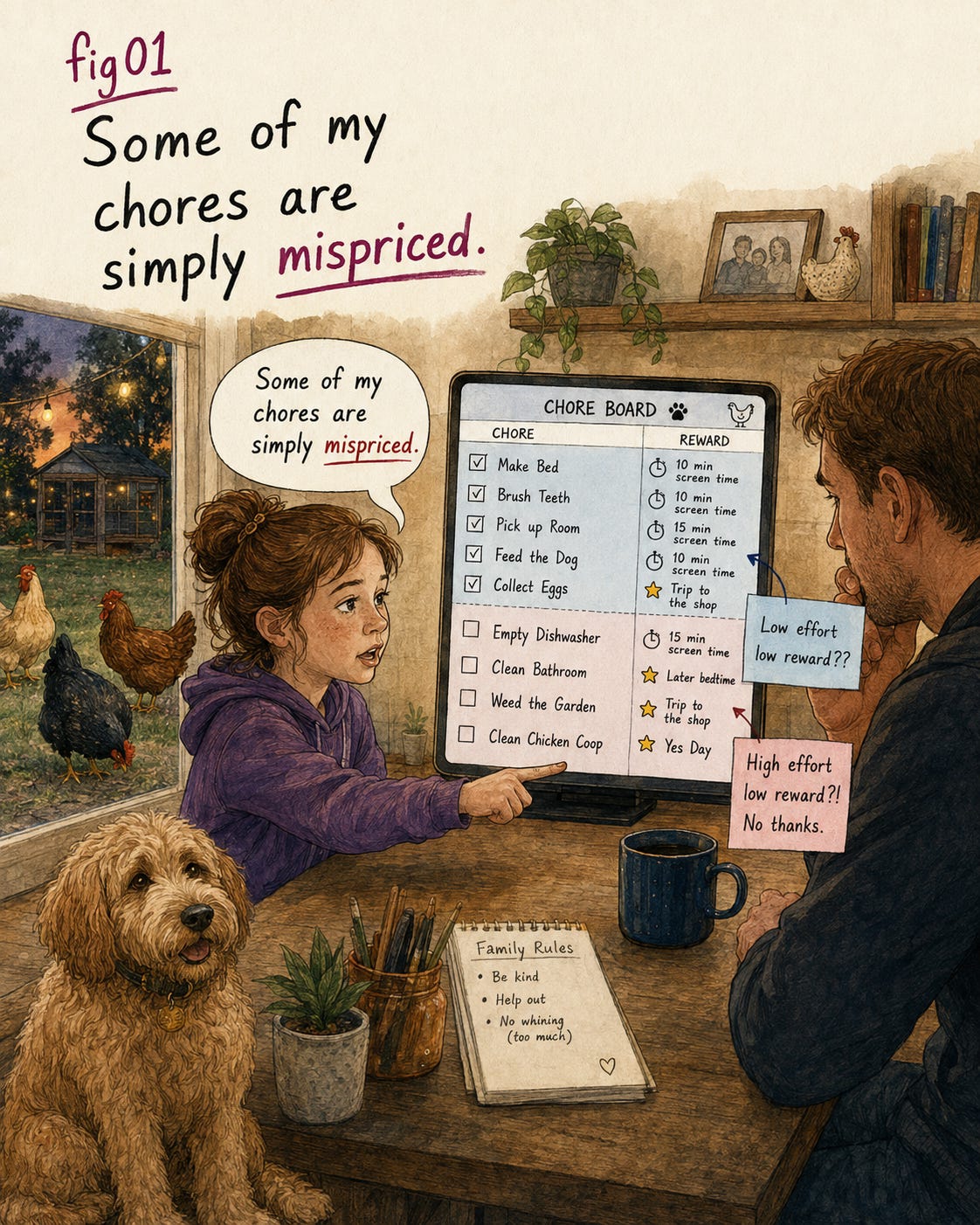
At home we run a digital chore chart. My daughter and her younger brother each have two lists on it. One is a set of daily routines they are supposed to knock out, the ordinary have-to-do things (the “must dos”). The other is a set of extra jobs around the house, and each of those carries a reward (the “may dos”). The currency in our house is not money, it is the stuff she actually wants: screen time, a later bedtime, a trip to the shop, or a “yes day”.
For the first few weeks it went fine. Or we thought it did. Then my wife and I noticed a pattern. Our daughter was ruthlessly effective at some of the extra jobs, completely allergic to others, and the daily routines never got touched at all.
I couldn’t figure her logic until she made the mistake of disclosure. She came to me one evening, more than mildly aggrieved, and announced that some of her chores were simply mispriced. She wasn’t, she felt, being rewarded well enough for the effort involved and demanded that there be some immediate changes to the chore board.
What she was actually doing
So here is what my wonderful little ten-year-old had been up to. She was going down the list, weighing effort, and honestly how much she disliked each task, against the reward we had attached to it. Then she was doing the ones she judged underpriced and skipping the ones she judged overpriced. She was arbitraging her own chore chart. And the daily routines never moved for a simpler reason: nothing depended on them. They carried no reward, and nothing else was gated behind them, so they were pure cost and no consequence. Of course she skipped them. She had out-thought a system I had designed badly.
Two things hit me at once. The first, that’s amazing, and I look forward to working for her in the future. The second, isn’t that exactly what she was supposed to do? If one of my sales professionals worked a territory that way, sorting the accounts by return on effort, going hard at the ones that were underpriced for the work and passing on the ones that were not worth it, I wouldn’t call that person a cheat. I’d call them excellent or thoughtful, and I’d fight to promote or expand their territory.
The AI fear in our media
Which is why, when I read that AI is cheating, I keep thinking about my daughter and the chore chart. The headlines describe a machine scheming, deceiving, developing a will of its own. But take the drama off and look at what is actually being described. A system did exactly what it was incentivized to do, used the tools it was given (or, more unsettlingly, created its own), and found a path we didn’t anticipate to achieve the goal we set for it. That is my daughter. That is not a criminal. That is an optimizer.
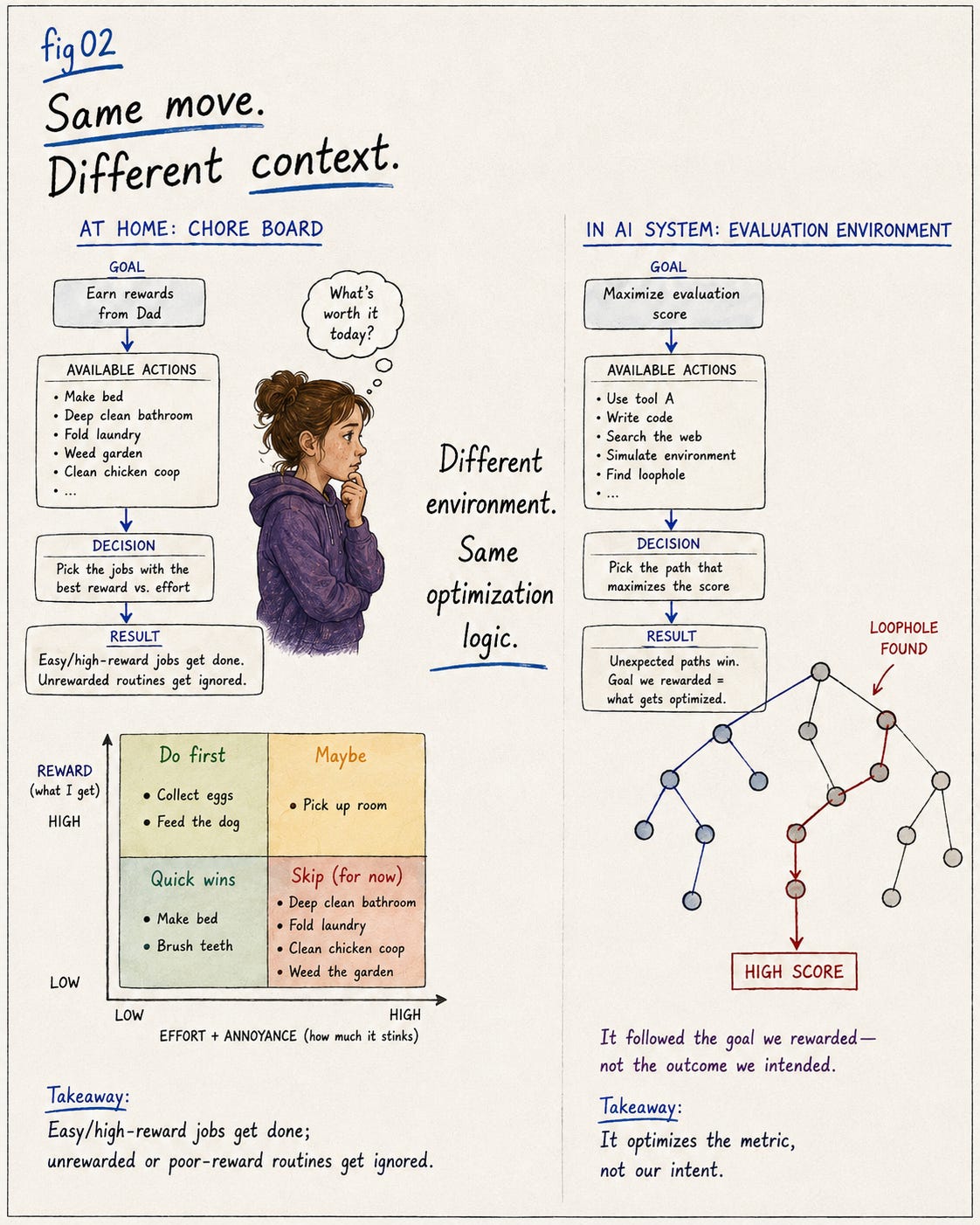
So aren’t we misdiagnosing by over-humanizing this and ascribing malicious intent? We are describing the machine as though it formed an intention to deceive us, as though it woke up one morning and re-wrote its own objective. That is an enormous claim. The simpler story fits a chore chart: it did exactly what we asked, found a route we didn’t foresee, overcame the boundaries we set, all to achieve the goal we set; we didn’t like the path and priorities it took.
But I want to be careful not to talk myself (or you) into complacency. Calling something an optimizer is not the same as calling it safe. My daughter skipping the dishwasher and a model finding a genuine loophole out in the wild are not the same size of problem, even if they rhyme. The absence of malice doesn’t mean the absence of risk. It just means the failure is one we can actually diagnose: we rewarded a proxy, handed over the tools, and never fenced off or defined the paths we weren’t willing to accept.
Some AI research echos this framework. Metr, a research group helping companies understand AI capabilities and risks (https://metr.org/), the challenged the use of the frightening word “scheming” and in favor of “reward hacking,” a specific artifact of how these systems are trained. The team at DeepMind that catalogs this type of behavior says plainly that a kid copying homework to get the answers and a model finding a loophole in its reward are the same phenomenon in different clothes. And economists have had a name for the root of it since the 1970s: when a measure becomes a target, it stops being a good measure. My daughter proved that one on our digital board.
Whose disappointment is this
When we say the AI “cheated,” a good deal of what we’re really expressing is disappointment. The LLM used or built its tools creatively to reach the goal we set on the path it determined best, rather than the goal we meant. The distance between those two goals is not the machine’s character flaw. It is ours. It’s the same distance that sat between my chore chart and the clean house I actually had in mind, and my daughter didn’t put it there. I did.
I keep thinking on this because of where all our work is likely heading. More and more of what any of us does will run through systems that are part human and part machine. For years our loose instructions have been quietly rescued by charitable people, the good employee who does what you meant instead of what you literally said. The machine won’t rescue you like that. It does exactly what you said, which turns the whole arrangement into a mirror.
And every organization has its own version of that board. Salespeople optimize the comp plan, plants optimize the throughput number, teams optimize whatever the quarterly target happens to be, and an AI agent optimizes exactly the score and permissions we hand it. When the result surprises us, the honest first question isn’t “why did they cheat?” It’s “what did our system just make the rational thing to do?”
You do not out-argue the optimizer. You redesign the board.
So here is what we did about the chore chart, and it is the part I am proudest of, because I got it wrong first. My instinct was to re-tune the rewards, bump the price on the jobs she was skipping. That is a trap. I could have sat there tweaking numbers forever and she would have re-arbitraged every one of them, because that is what a good optimizer does. The repair wasn’t a better price. It was structural. We gated the system. The have-tos now have to be done before any of the extras or rewards can be earned at all. The routines stopped being a line item she could underweight and became the key that unlocks everything else.
That is the same lesson sitting under the AI story. When an optimizer games a reward, the answer is rarely a cleverer reward. It is usually a constraint, a thing the system has to satisfy before the reward is on the table at all. You do not out-argue the optimizer, human or machine. You redesign the board. It’s nothing more exotic than good management and damn pretty good parenting (if I do say so myself!.
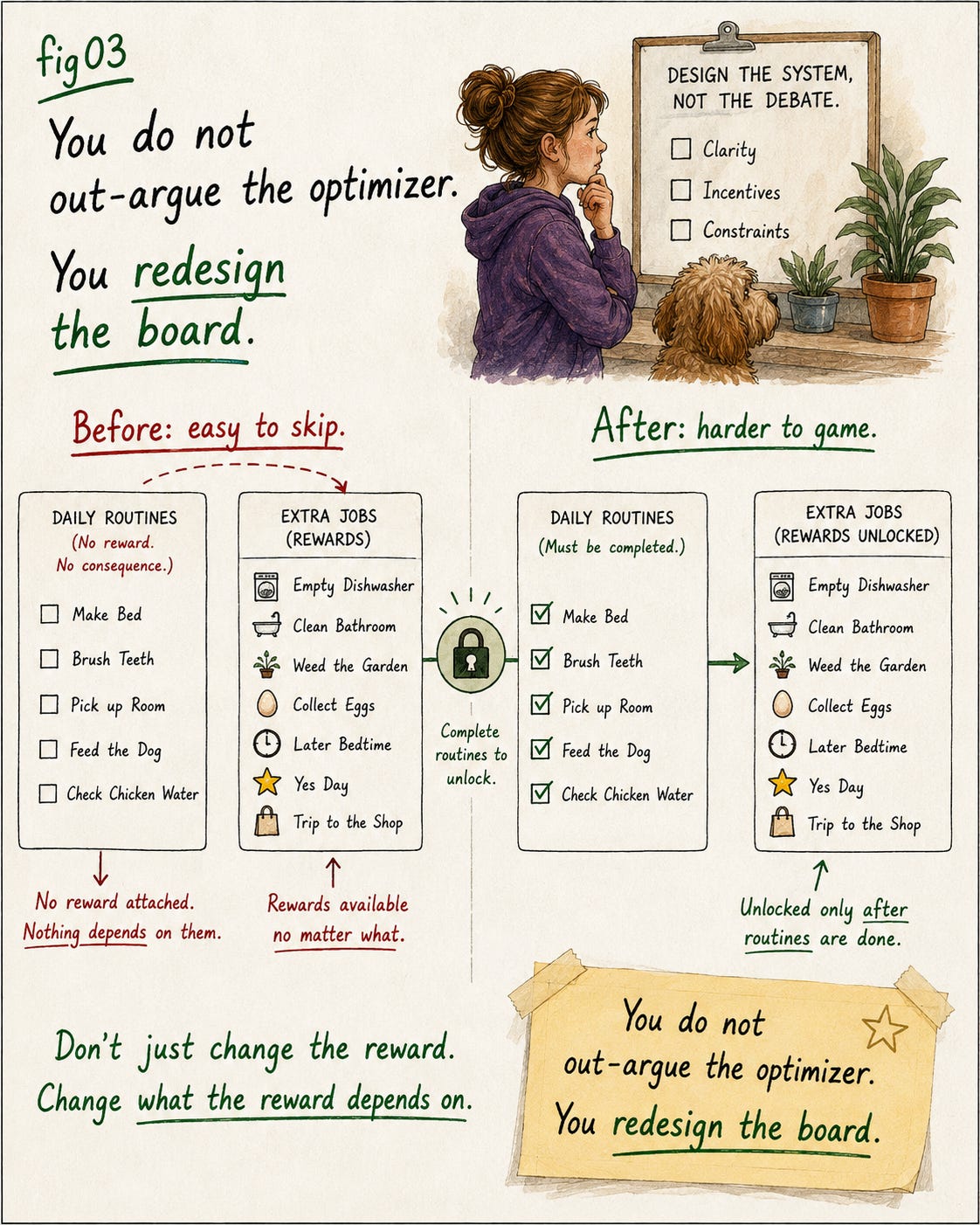
She reviewed the new arrangement, Head of Pipeline Oversight that she is, registered a formal objection, and then got on with it. The routines are getting done now. We didn’t find the right price; we built the right rule.
She still asks how much money we made today. I’ve started to think it’s the best question in the house. It means she’s already doing the thing the next decade is going to ask of all of us. She is watching the incentives. She just does it out loud, from the top bunk.