

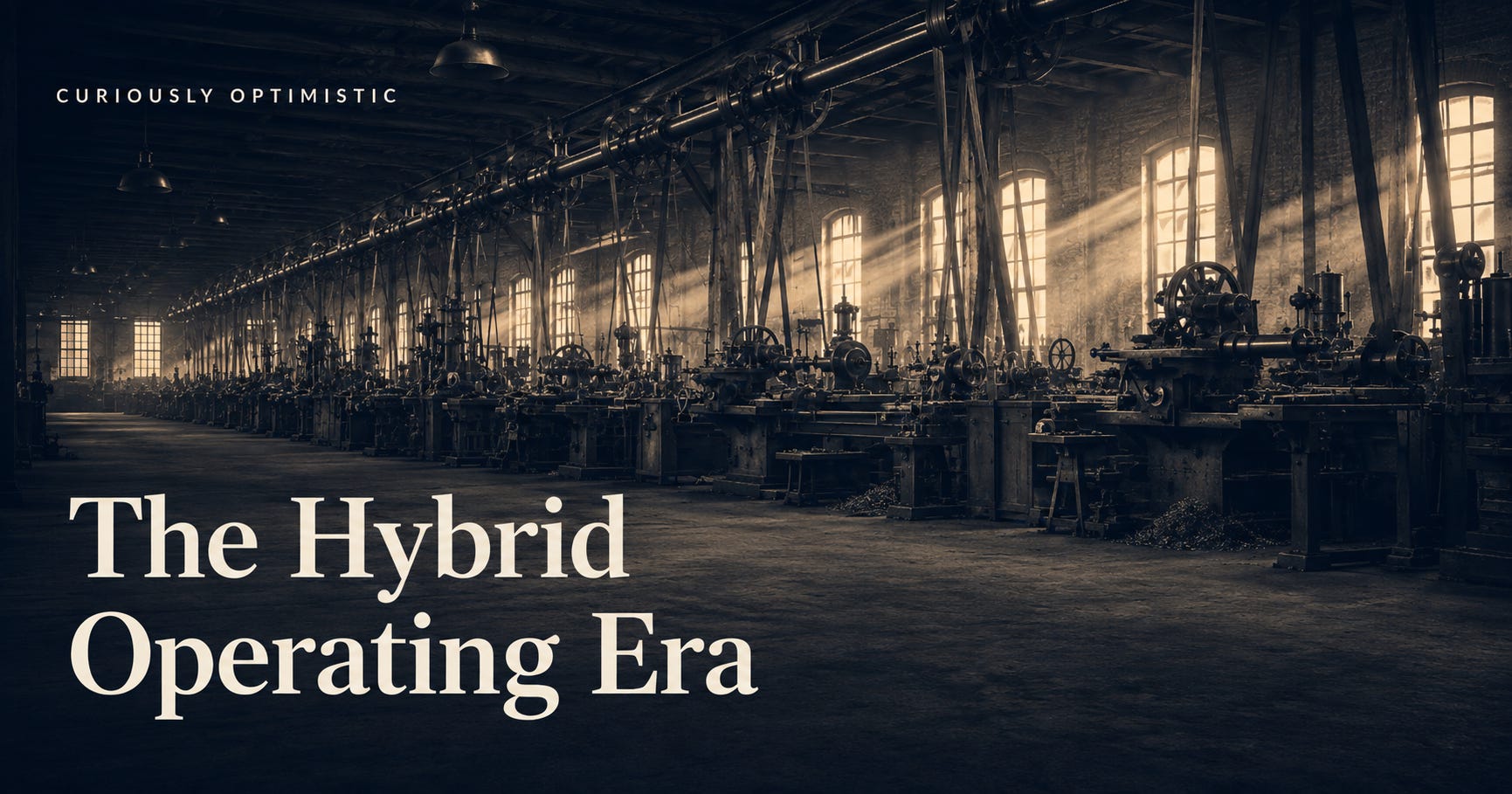
Most organizations bought AI and just bolted it onto their old org chart. The productivity gains are not showing up for the same reason they did not show up in the 30 years factories kept the steam-age floor plan after the electric motor arrived: the technology is new but the architecture and processes around it are not.
This is the awkward middle.
The shift is really about a new kind of participant at your table rather than a new tool on the table. As a result, you should be thinking about the redesign of your team layer by layer, and you might just be about to cut the exact group that would enable your success.
For over 30 years after the electric motor arrived, factories kept the layout of the steam age. There was still one big engine, a tangle of line shafts and belts running overhead, and every machine crowded close to the power source because that’s how you fed them. Owners bought the new tool and bolted it onto the old architecture. The productivity gains everyone expected didn’t show up. A generation of managers later stopped asking “where do I put the motor” and started asking “what could (should?) this layout look like if my primary constraint was throughput, not power distribution.” With the benefit of power arteries and flow, the productivity promised was finally realized and these leaders ran the next fifty years of industry.
I think we might be living in an equivalent stretch. Most organizations have the new technology, but they just bolted it onto yesterday’s architecture. Robot agents, fresh out of the box, sit next to the work the way those first electric motors sat next to the line shaft. We are in the awkward middle, and it helps to name it as a middle, because middles end.
The shift underway isn’t really about AI as a technology. It’s about what happens when a genuinely new kind of participant joins the way work gets done. “AI replaces jobs” is the wrong frame just as “AI is just another tool” is too. Agents don’t replace people, and they don’t stay politely in the tool layer where software has lived for 40 years. They show up as something in between: a new set of hands, a new rhythm, a new perspective at the table. A new participant forces every organization to answer questions it hasn’t had to answer since the factory system produced the first professional managers 200 years ago.
Every time humans invent a new way to coordinate work, 3 things commonly happen. First, the organization restructures around it. Then, a new managerial class emerges; but only as the prior generation retires. That was true when the master-apprentice guild gave way to the factory, when Ford turned people into standardized components, when Drucker named management as a discipline and the paper-pushing, orchestrating middle layer exploded, and true again when reengineering and ERP software did the translation work and thinned that layer out.
The pattern is familiar but perhaps this time we’re facing a different pace. Scientific management held for more than 39 years. The reengineering wave held for maybe 15. This transition gets 5 (maybe 10…ChatGPT as we think of it was 2023). Cycle time is compressing, which means the penalty for redesigning late is compressing too.
The inversion nobody put in the brochure
For 3 decades, business software taxed the worker to benefit the organization. Salesforce, Workday, SAP, pick your acronym. Every one of them was, at the point of use, a compliance problem. Somebody at the top wanted visibility, so somebody at the bottom spent Friday afternoon typing what they’d already done into fields designed for a dashboard they’d never see (and fearing it was information that no one would ever act on). Value flowed UP. The cost flowed down. We called it adoption, and you spent fortunes on change management trying to force it and convince everyone it was a good idea.
I think the robot agent could invert that. Done right, the system now serves the person doing the work instead of the other way around. It captures and adapts to what they already do rather than asking them to re-enter and adapt to it (where is that toolbar?). It can interview a salesperson at the end of the day and write the notes for them. The compliance problem doesn’t get solved. It disappears, because you’ve stopped asking anyone to comply. When the tool finally works for the worker and not against them, adoption stops being something you enforce and starts being something people reach for.
The second change compounds the first: the cost of adopting and adapting collapses. A 1995 ERP install took capital, a team of consultants, and two years. A 2026 agent stack takes a subscription and a weekend. That sounds like an IT footnote. It isn’t. It means the two-person shop with a well-built agent fabric can now do work that used to require the two-hundred-person incumbent, and can do it before the incumbent has finished scheduling the steering-committee kickoff. Advantage used to accrue to whoever could afford and harness the biggest system. Now it accrues to whoever redesigns fastest around an effective one.
Small teams operate at a scale that would have been laughable five years ago. Large ones move at the speed their approval process always allowed. That gap is the whole story.
Invitation, not fear. Perspective, not bias.
If the mechanics are changing, the leadership job is changing more. It is mostly a job of framing.
Every organization gets to choose the emotion it puts around adaptation, and it matters much, much more than your tool selection. Fear of replacement produces exactly what you’d expect: hoarding, sandbagging, quiet resistance, people protecting the parts of their job that a machine could do because those parts are what they think they’re paid for. Invitation produces the opposite: experimentation, disclosure, people showing you where the pain actually is.
Perhaps the agent takes away the work people never actually wanted and gives back the work they came here to do. The salesperson who hated the CRM gets to sell. The analyst who drowned in formatting PowerPoint gets to pattern-match. The transition is something people pull toward instead of brace against. This is leadership’s real task in this era, and it isn’t explaining the technology. It’s inviting people into a different, less constrained, and better (read: more valuable) version of their own work.
Further, a companion mistake is treating the agent as a bias, untrustworthy (it hallucinates), something to be contained. A lazy version goes: humans are biased, machines are objective, so let the machine check the human. That’s wrong in both directions. What a good leader actually works with has never been objectivity. It’s a collection of perspectives: the operator’s read and the banker’s read and the founder’s read and the customer’s read, each one partial, each one valuable, none of them neutral.
Your agent is simply a new perspective to add to that table. Not a flawless one. Not a bias to contain. A useful one to integrate. Leaders who treat it as bias to manage end up playing defense and inducing fear while leaders who treat it as a perspective to integrate are playing offense. In both cases the edge that matters is the same one that always mattered: the quality of the synthesis, decision, and impact to the customer. The reality is machines, digital or not, make good synthesis cheaper to feed and more valuable to possess.
What does redesign look like layer by layer?
Redesign lands differently at each level of the org chart, and “we’re becoming an AI-first company” is not a plan. The CEO’s job narrows to the thing only the CEO can do: own the value narrative and set the priorities. In a world where raw capability is cheap, someone has to be able to answer what the customer is actually getting from us that they can’t get somewhere else. The failure mode is the chief executive who hands the whole thing to a newly minted AI officer and then can’t answer why we’re doing “this” and what “success looks like” in the next board meeting.
Maybe your executive team should just own the redesign in their functional areas. Each segment runs its own tidy pilot in its own silo. Every pilot of course succeeds on its own terms and definition. Nobody owns the cross-functional workflow where the customer value actually compounds. Hooray…the pilots pass but the company doesn’t move.
Then there’s middle management, and I think this is the layer people oversimplify most. The popular story says middle managers were information plumbing and the plumbing is now automated, so cut the layer. But plumbing was maybe a third of the job. The rest was coaching, judgment, conflict, hiring, and holding the tacit knowledge that never made it into any document. That part doesn’t vanish. It gets smaller in volume (maybe) and higher in value (definitely). The great middle manager doesn’t disappear. They get a broader span, a higher bar, and a title that shifts from Manager of X to something closer to Operator of X. The failure mode is flattening by layoff instead of flattening by redesign: cutting the layer to hit a number and discovering you removed the people who actually made the work cohere.
Finally, I think the junior layer is where the real mistake is about to be made. The instinct is to hire fewer of them, because agents can now do entry-level work. That is a five-year win and a fifteen-year disaster. Judgment is built by experience. The diligence analyst who has never read a terrible CIM cannot smell a terrible CIM. Automate away all the entry-level reps and you also automate away the apprenticeship, and in a decade you have no one who experienced how your business runs.
The right move isn’t just hiring fewer juniors. It’s deploying them differently. Fewer of them, perhaps, but higher autonomy, increase expectation in delivery (move the ball farther…), engaging and running agent teams from day one, rotating deliberately through the judgment-dense work that actually builds experience, and increased touchpoints from leaders who provide real feedback (with clear expectation of adaptation).
The apprenticeship pipeline is the real risk in this transition. It shows up last on the P&L, hurts the most, and will require your leadership teams to lead differently.
The test, and what doesn’t move
One question tells offense from reaction: what is our customer getting from us in 2030 that they can’t get now, and what operating model do we need to best deliver it? A clear answer is offense, and it compounds for a decade. Silence, inconsistency, or a list of the AI tools doesn’t. The quality and alignment around that answer are the best predictor of your success.
Transitions make people forget the “real” objective, so anchor them:
Customers buy outcomes, not org charts.
Trust compounds slowly and breaks fast.
Judgment and leadership matter most at the edges, where the playbook and process are not yet written.
Every meaningful transition carries loss: some skill that people invested twenty years in will matter less than it did, and leadership that pretends otherwise forfeits its credibility. Naming the constants isn’t nostalgia. They’re the fixed stars you navigate by while you rearrange the floor.
We rearranged the factory floor once we stopped treating the motor as a thing to place next to the old machine. Don’t redesign your shop floor around last year’s constraint.
If you are redesigning around this right now, how is it going? What are you stuck on? What’s working? What’s not? What am I missing? I’d love to learn from you.