

In May, Smart Business ran a Northeast Ohio dealmakers piece, and I was one of the people they talked to. The through line of my thoughts at the time were as follows:
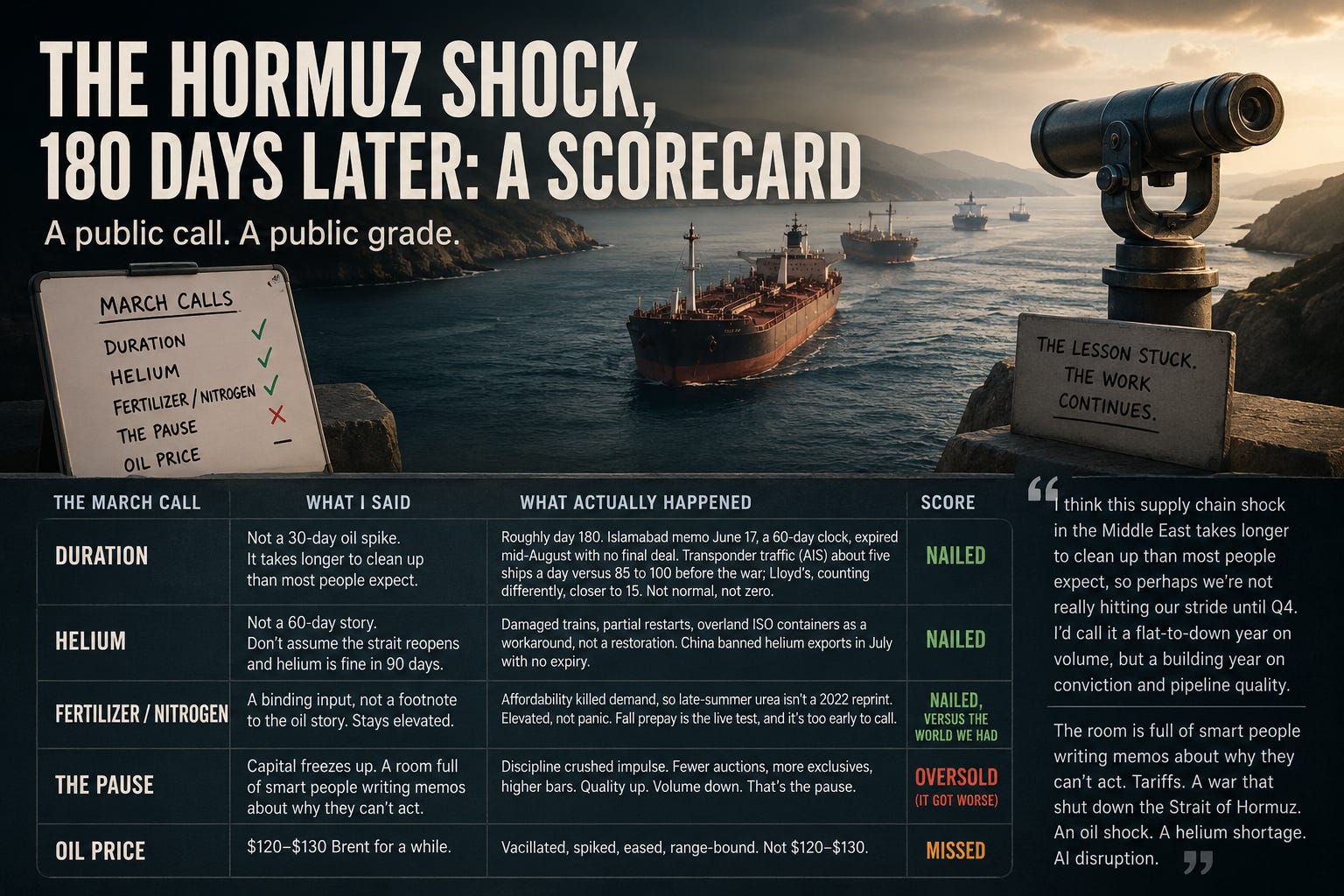
I think this supply chain shock in the Middle East takes longer to clean up than most people expect, so perhaps we’re not really hitting our stride until Q4. I’d call it a flat-to-down year on volume, but a building year on conviction and pipeline quality.
And I was bias a negatively on the institutional investing market:
The room is full of smart people writing memos about why they can’t act. Tariffs. A war that shut down the Strait of Hormuz. An oil shock. A helium shortage. AI disruption.
Next week I’ll take a real crack at where chemicals and materials go from here. Grading myself publicly, for “fun”…
What I was actually saying [in March]
The above remains the headline, but I thought then, as I do now, that this is much bigger than energy. It really is a supply chain reset:
This isn’t just an energy shock. It’s a chemicals and materials shock. Urea, sulfur, helium, naphtha. Food, fabs, fiber, pharmaceuticals. Same week.
I think that piece changes how you underwrite and look at the durability and competitive position of a business. When the input cost can move 50 percent on a headline, the diligence question stops being “what are your margins” and becomes “what happens to your margins when your input costs double overnight” not to mention if you can actually get the input materials delivered. Diligence used to be financial, legal, environmental, commercial, done. Now supply chain resilience is its own workstream.
And the line I believe more today than I did in March:
Even if the Hormuz situation stabilizes, and we’d all certainly welcome that, the structural lesson doesn’t change. Global supply chains are a liability for any business that depends on a shipping lane through a contested waterway, and buyers have permanently internalized that into how they evaluate targets.
So that’s the frame and Hormuz is not the only contested waterway. Here’s how the calls actually did.
The scorecard: three I nailed, one I oversold, one still open
Duration — Nailed. I said: not a 30-day oil spike, it takes longer to clean up than most people expect, and “soon” was never the right word. What happened: roughly day 180. Islamabad memo June 17, a 60-day clock, expired mid-August with no final deal. Transponder traffic (AIS) about five ships a day versus 85 to 100 before the war. Not normal, not zero.
Helium — Nailed. I said: not a 60-day story, don’t assume the strait reopens and helium is fine in 90 days. What happened: damaged trains, partial restarts, overland ISO containers as a workaround, not a restoration. China banned helium exports in July with no expiry.
Fertilizer / Nitrogen — Nailed. I said: a binding input, not a footnote to the oil story, and it stays elevated. What happened: affordability killed demand, so late-summer urea isn’t a 2022 reprint. Elevated, not panic. Fall prepay is the live test, and it’s too early to call. We should all be thinking about impact on food supplies.
Oil Prices — Wrong. I would have thought prices would have more permanently reset higher. Admittedly, I’m writing about a market with intricacies that others know much better than me. That said, if you told me ~20% of the global oil supply was left trapped. That perhaps alternative shipping and pipelines, forced reduction of consumption of demand in Asia, and release of global strategic reserves might off set ~50% to 75% of the shortfall, and much of that is a shot in the arm, not a permanent fix. I still would have thought oil would be higher.
The M&A Pause — Oversold. Half right, half dumb. I said: capital freezes up, a room full of smart people writing memos about why they can’t act while the deals go to whoever’s willing to move. What happened: not a freeze. The tape kept moving all summer. Investment seems to have gotten more selective: the “good” books cleared at very high values, commodity barely did, and a signed mega-merger still fell apart.
Q4 M&A stride — TBD. I said: not really hitting our stride until Q4, flat-to-down on volume, a building year on conviction and pipeline. What happened: first week of September, so Q4 hasn’t started. Still digesting, not striding. If “stride” meant the deal year finding its feet, I may be a quarter or two early. Let’s see what happens in the next two weeks (every year we race to publish books in September and shoot for a year end closing). Bet you there’s less of a race this year and the common logic slides to spring. The healthy IPO and stock market makes everyone feel good about deploying…
If you’re generous, call it three and a half out of five combining supply chain and M&A. I did good on duration, okay on supply chain and prices (ex-oil), and M&A stayed stronger than I would I have told you in March. Let’s call it a B- overall.
Going a little deeper on M&A
I said capital would freeze. In the same article I also said the structural forces, dry powder, carve-out supply, aging PE assets, LP impatience, don’t stop because of a war or a tariff headline, they build. I think that remains the right instinct. In March, I acknowledged that pressure and still called for a pause anyway. Dumb…
Not surprising, capital doesn’t sit on its hands. Through July the chemicals and advanced materials tape was moving, and not quietly. Olin and Huntsman put together a $12B-plus merger of equals and got it shareholder-approved. AkzoNobel and Axalta did the same in coatings, an all-stock merger of equals their shareholders backed. Private equity and sovereign money kept taking carve-outs: Carlyle and Qatar’s QIA closed the BASF Coatings business in July, a €7.7B deal, and Berkshire closed OxyChem for $9.7B. Europe’s commodity petchem kept clearing too…counting distressed and sometimes negative enterprise value.
The multiples say the same. Lincoln’s Q1 chemicals print was about 12.4x mean and 8.9x median EV/EBITDA, and PE deal value in chemicals had already compressed before the war (roughly $5.9B in 2025 against $20B across 278 deals in 2021…post-covid rush). So the better version of this isn’t “nobody transacted” or fear causing paralysis. Instead, it’s that capital continues to get more picky. I said freeze…the market said filter.
So what, and where I think we are
The world is already building away from the strait. Ugly in places, expensive in places, and a lot of it won’t reverse when this finally ends. Livable pain gets adapted around, and the workaround is already making the blocked lane tolerable for anyone who can afford it. That lowers the urgency of a handshake.
Since fall 2019, there’s been a new reason to wait every quarter. The firms getting deals done aren’t the ones with the best analysis. They’re the ones who structure around imperfect information and go. I still think that’s right. I also think there’s a real chance leaders misplay this: wait for an all-clear that doesn’t come, or call it over because oil eased, and miss the fertilizer, the helium, the plants that don’t restart. Long-term economic harm. And there is real human harm.
What I don’t think goes away
A few things the scorecard points to that I don’t think are temporary.
The two-speed market continues. Spec-driven specialty with domestic supply on one side, import-tied commodity on the other, and the gap between them widens rather than closes. These aren’t mood swings. They’re structural drivers for activity: reshoring, second-sourcing, and supply chain resilience now priced into every diligence.
And the attractive end stays expensive. Specialty and tech platforms cleared all summer, commodity barely did, and I don’t see what makes the good assets cheap from here. That theme was true before 2026 and this year has only further solidified that.
Next week: where this is actually going
This week I looked back. Next week I put in writing where I think things are going looking forward: which segments the structural drivers reward, where the two-speed split ends up, what stays expensive and why, and what an operator does about it now instead of after the all-clear.
In 6 months, we can reflect again and see where I’m “smart” or dumb…
If this resonated, I go deeper on ideas like this in Curiously Optimistic. I always welcome a dialogue, so please challenge me on my perspective.