

Most weeks I skim The Daily Shot, a daily newsletter of market and economic charts, and file it away. I lean on it because it pulls charts from many primary sources into one read, so you can see the whole economy at once. Last week wasn’t a skim-and-file week. The charts told two stories at once, and I have a hard time seeing them as separate.
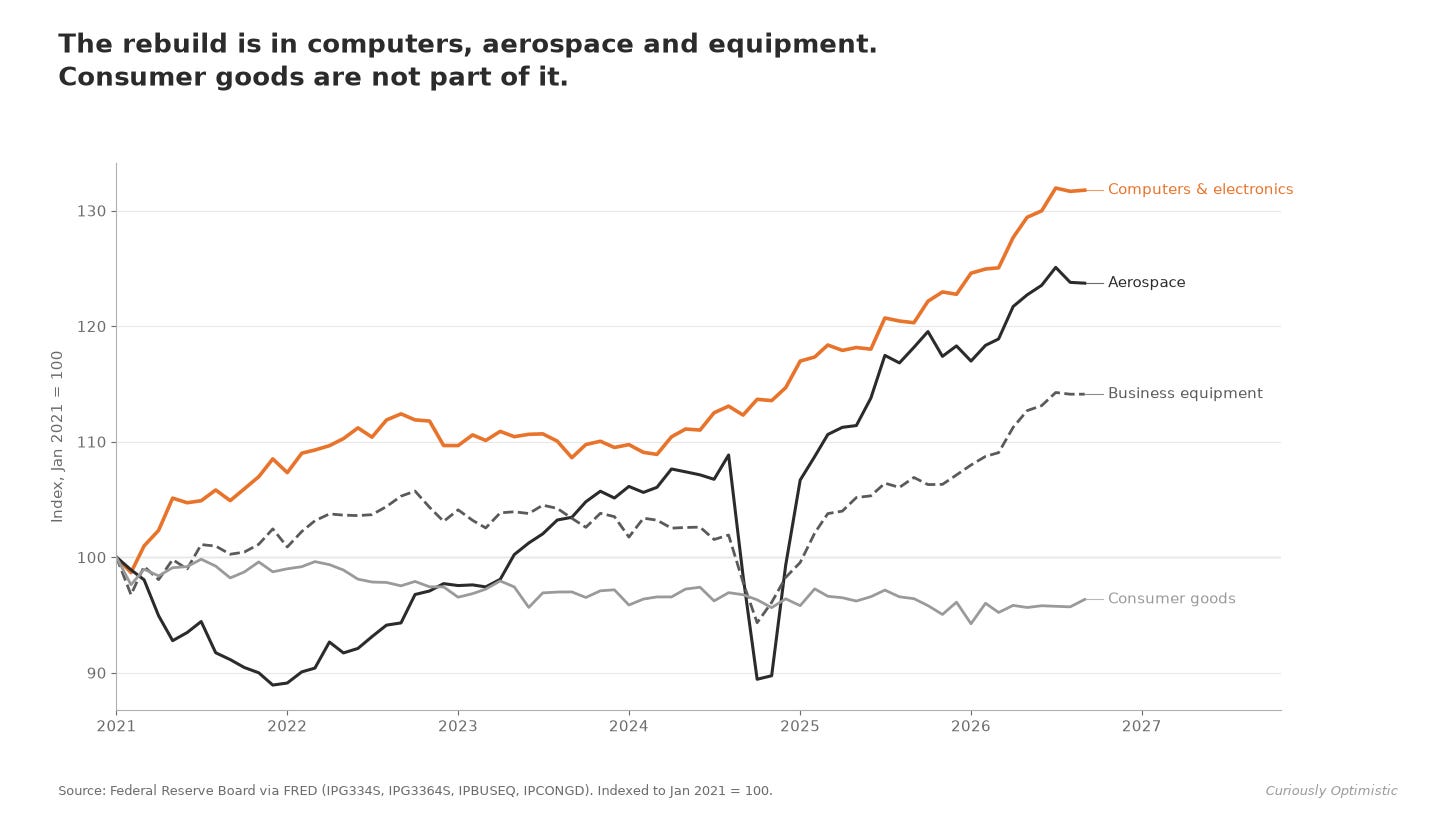
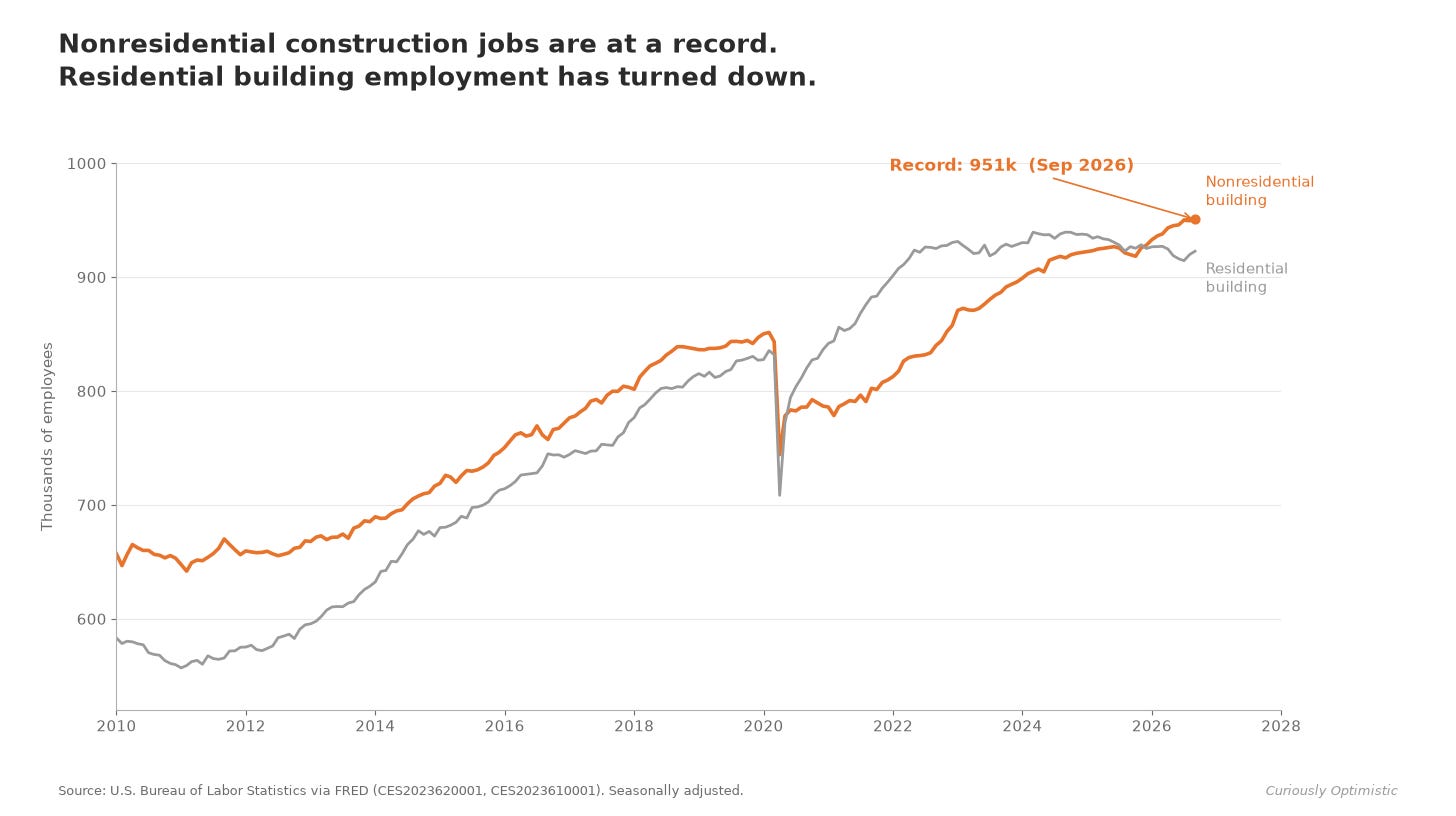
The first story is that the real economy is rebuilding. September industrial production came in ahead of expectations and the gain was broad, with utilities surging and manufacturing led over the past year by computers, electronics and aerospace (Daily Shot, 10/19). Semiconductor output rose at a 28.4% annual rate in the third quarter, and capacity utilization rose to 76.9%, still below its long-run average (Federal Reserve, 10/16). Nonresidential construction jobs are at a record high (10/21). That isn’t a consumer boom. Consumer goods output kept contracting (10/19). It’s power, defense and hardware.
The second story is that the chemistry underneath all of that is getting squeezed, and squeezed hard.
The build is real, even when the stocks aren’t
AI stocks had a rough week. On 10/23 the Nasdaq 100 had its worst drop since June and chip stocks fell 6.7%, with money running to Treasuries (10/23). The Daily Shot noted that all parts of the AI theme have been correcting for roughly five months (10/22).
And yet the spending hasn’t slowed. Hyperscaler capex has climbed faster than in any earlier investment boom, including canal mania, the railways, the Roaring Twenties and the dot-com era (10/22). Capex estimates are still rising (10/21). Asian chip and hardware earnings forecasts keep going up (10/20). Japanese chip-equipment makers are expected to grow strongly (10/23). Malaysia’s exports hit a record on AI-related electronics (10/19). Data-center hiring in Europe is accelerating while other tech hiring stays soft (10/20). US import prices for computer parts are still up nearly 50% year over year (10/19).
The practical reality is that the build keeps going whether or not the multiples hold. How it gets paid for matters too. J.P. Morgan estimates only about 20% of 2027 AI capex will be funded from free cash flow, with roughly 80% needing outside financing (10/26).
Every one of those servers, fabs and substations runs on materials and chemistry: high-purity process chemicals, specialty polymers, adhesives, coatings and thermal materials. That layer barely shows up in the AI capex conversation. It’s the most under-discussed part of the stack. It may take a while to show up in the numbers, but it’s there.
The squeeze: energy and China
Now the other side.
Energy is pushing input costs up almost everywhere. US gasoline is up about 40% from a year ago, to more than $4 a gallon, as the Iran conflict pushes oil higher (10/19). Euro area inflation hit 3.8%, led by energy (10/19). German producer prices surged (10/20). Canadian producer prices jumped (10/23). Japan’s manufacturing PMI showed input-cost pressures surging (10/23). US manufacturing price pressures jumped in the S&P Global PMI (10/26). Brent averaged about $124 a barrel in October, up from about $65 a year ago (EIA).
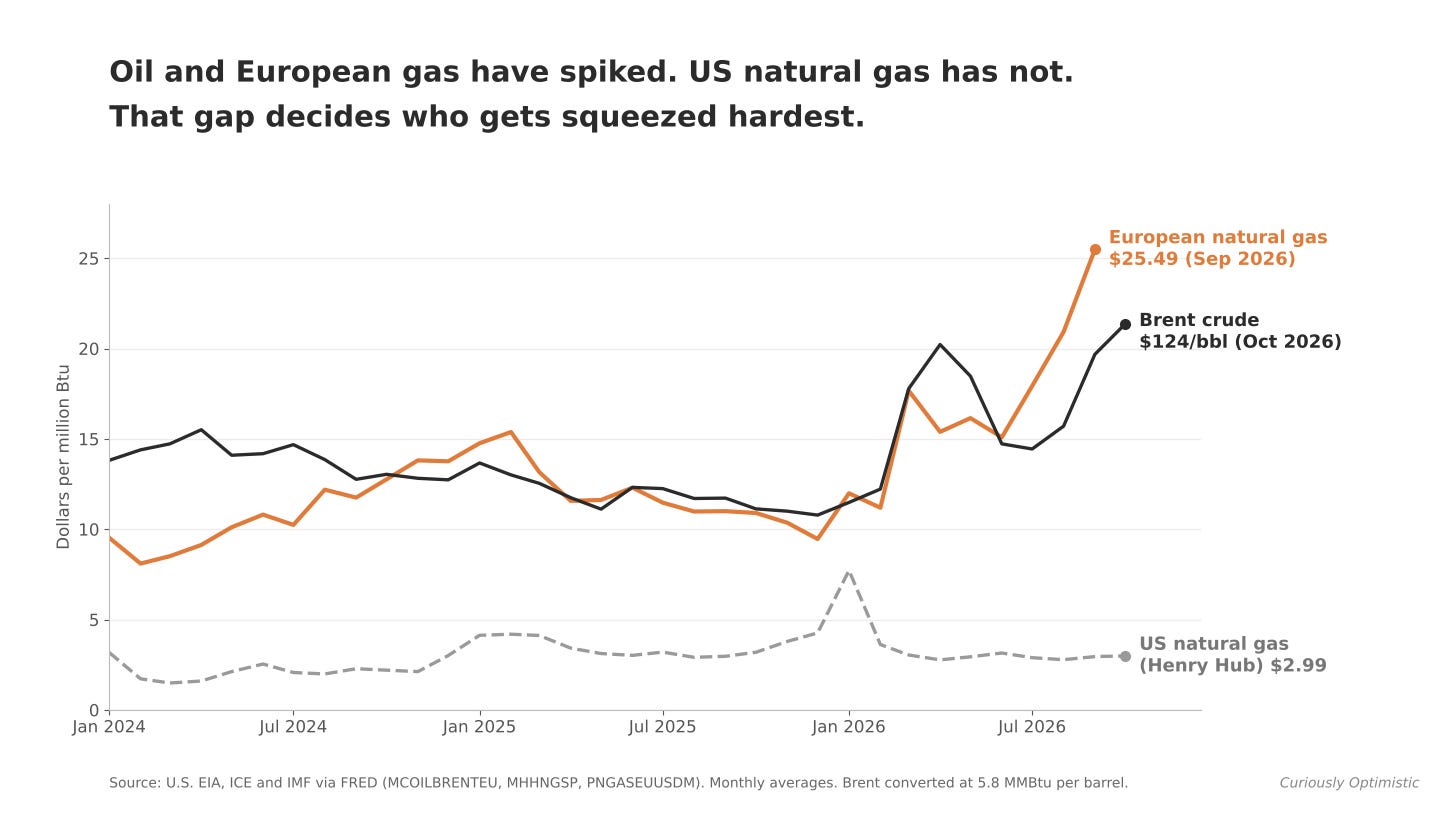
If you run a specialty chemicals business, that’s your raw material and utility bill. Some of it passes through. Some of it doesn’t.
The squeeze is on margins, not volume. US chemical output rose in September (Federal Reserve, 10/16). You can see it in the earnings. LyondellBasell missed third-quarter estimates on a polymer squeeze, guided its European olefins plants to about 60% operating rates (near technical minimums) and said US ethane is running about 24% above its third-quarter average (10/30).
Then there’s China. Q3 GDP picked up to 4.5%, and industrial production was led by chemicals and nonmetal products (10/19). But Chinese industrial capacity utilization sat at 73.1% in Q3, down from 74.6% a year earlier and near a two-year low (China National Bureau of Statistics, 10/20). So China is producing more chemicals into weak domestic demand, and that output has to go somewhere. The euro area’s goods trade deficit with China hit a record (10/19), and Chinese battery makers are expanding production in Europe (10/23).
Commodity chemicals in the West are going to stay under export pressure. But the policy response (trade protection) tends to help Western producers who make the qualified, spec-critical stuff that customers can’t just swap out. The squeeze isn’t even. It falls hardest on undifferentiated volume.
Housing makes it worse for one slice
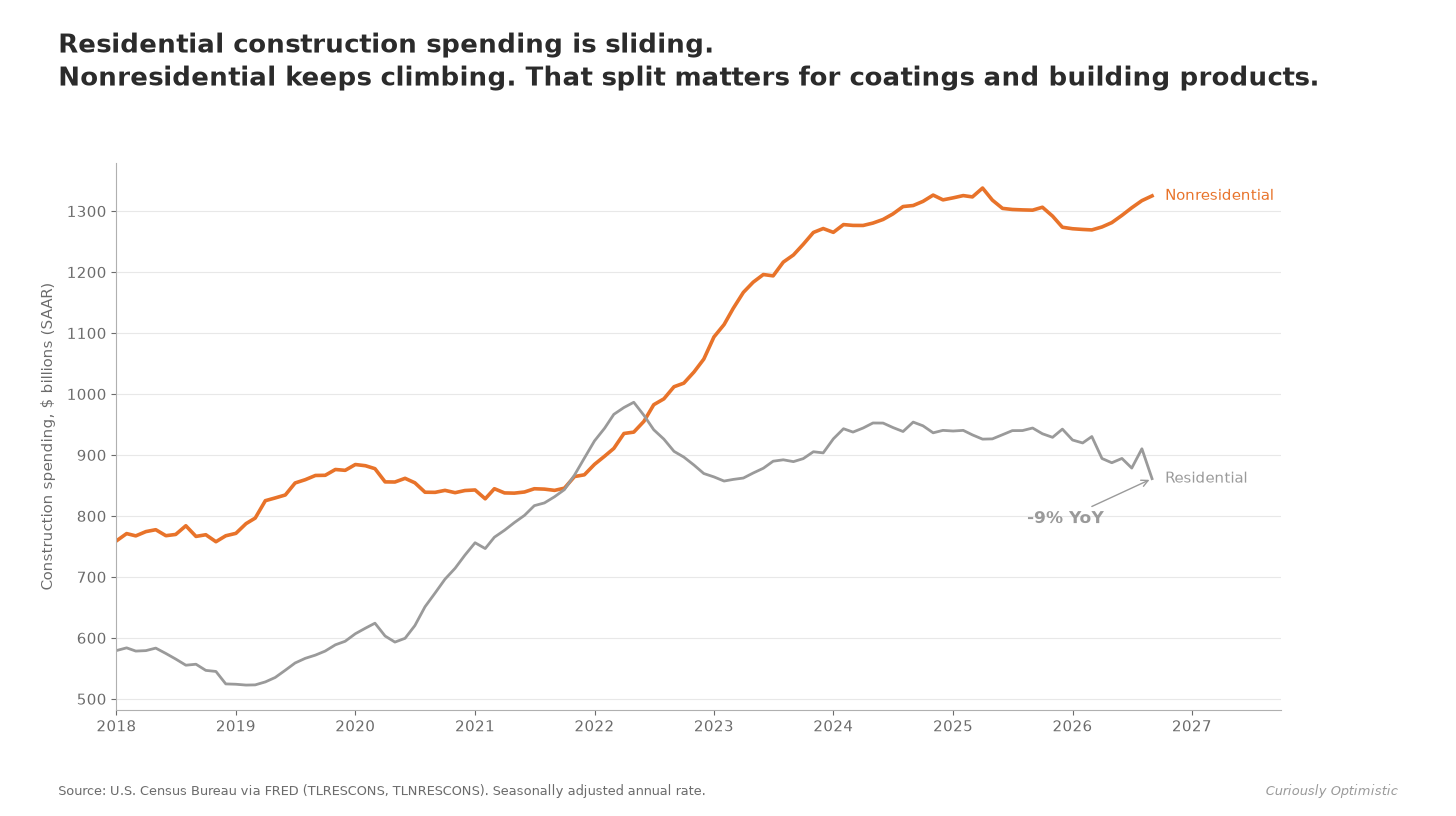
Interest rates are doing their own damage. Financial conditions tightened, mostly from surging long-term yields, and Goldman’s read is that they’ve gone from supporting growth to a modest drag (10/20). Homebuilder sentiment hit its lowest level in more than 14 years (10/20). Pending home sales fell to a record low (10/21). Residential construction employment has turned down (10/21).
So if your coatings, sealants or building-products volume is tied to new housing, I’d plan for soft demand into 2027. That’s a different business from the one selling into a data center or an aircraft program, even if the chemistry looks similar on paper.
Where the deals are
Here’s the through-line, as plainly as I can put it. The real economy is re-industrializing around defense, power and AI hardware. Chemicals and materials companies are getting squeezed by energy costs and Chinese overcapacity. The ones caught in the middle (good products with the wrong end-market mix, or a balance sheet built for cheaper money) are where a lot of the next few years of transactions will come from.
The supply of sellers looks like it’s building. The UK is a useful analog. Business sales there reached an eight-year high last year as founders chose to sell rather than scale (10/23). In the US, the lower middle market was the only private equity segment to grow in Q2 2026, with buyouts of $25 million to $100 million up 56% in deal count and 71% in value quarter over quarter, to 413 deals worth $16 billion (10/19). Meanwhile only 28 new US private equity firms have launched this year, versus more than 100 in each of the past five years (10/23). More sellers, steadier buyers, fewer new funds. That reads like a market where knowing the chemistry and the end markets is worth more than it used to be.
For an owner, the questions I’d ask are simple. What share of my volume goes to the build (power, defense, semis, data centers) versus housing and consumer? How much of my energy cost can I actually pass through? And am I making something a customer has to qualify, or something they can buy from anyone?
If you’d like to put numbers to the feelings on any of those, I’m happy to think it through with you. Challenge me on any of it. We’ll figure it out.
Sources: The Daily Shot, editions of 10/19, 10/20, 10/21, 10/22, 10/23 and 10/26/2026, cited inline by date; Federal Reserve G.17 industrial production release (10/16); China National Bureau of Statistics (10/20); LyondellBasell third-quarter 2026 results (10/30). Charts by Curiously Optimistic from FRED data.