

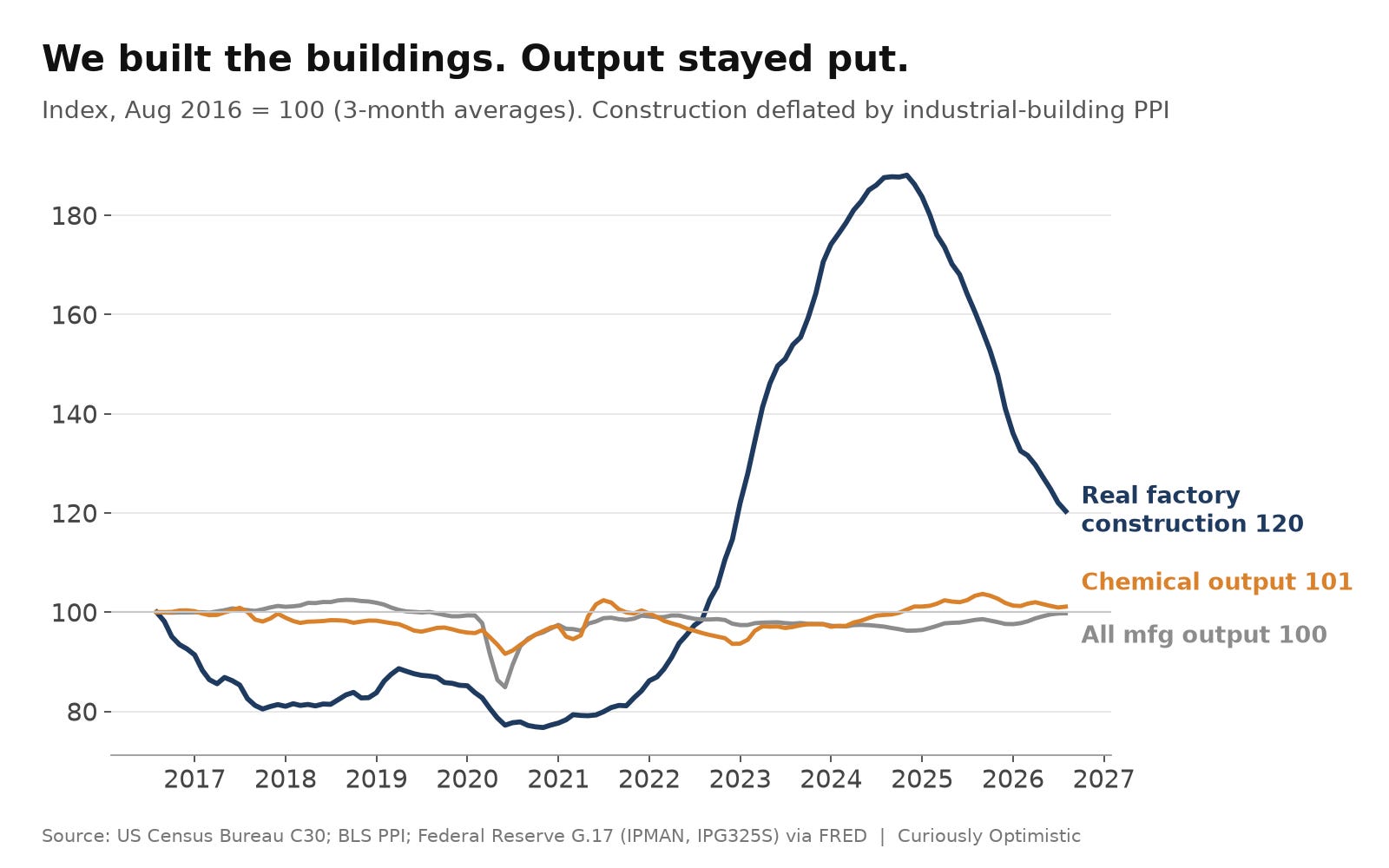
The short version. US factory construction peaked near $250 billion a year in late 2024. In August it was down about 20% from a year earlier, and almost all of that is one category: chip, battery and electrical plants, down 45%. Everything else is up about 1%. Over ten years, US manufacturing output hasn’t moved. Adjusted for construction costs, we’re building about a third less chemical plant than in 2016, and most of what we are building is drug plants and big commodity units. The starting materials, high-purity chemicals and explosives precursors that the new fabs, drug plants and munitions lines need are still mostly made somewhere else.
I’ve been asked some version of the same question a lot this fall. Is reshoring real?
Here is the honest answer. We reshored the buildings. We didn’t reshore the chemistry underneath them.
The factory boom was one boom
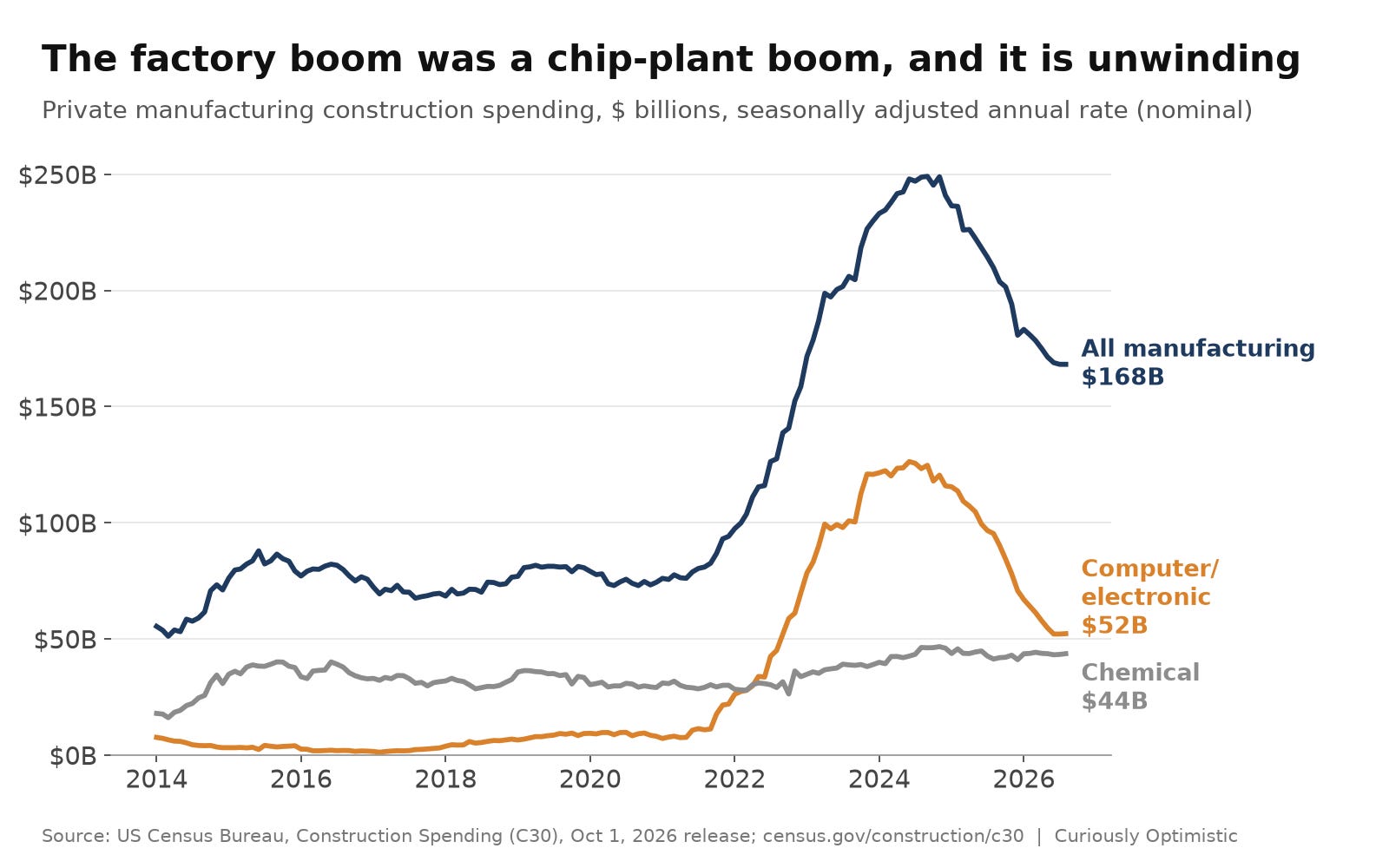
Start with the number everyone’s quoting. Private factory construction ran $168 billion at an annual rate in August, down about 20% from a year earlier (Census, October 1). That sounds like reshoring stalling. It’s more specific than that.
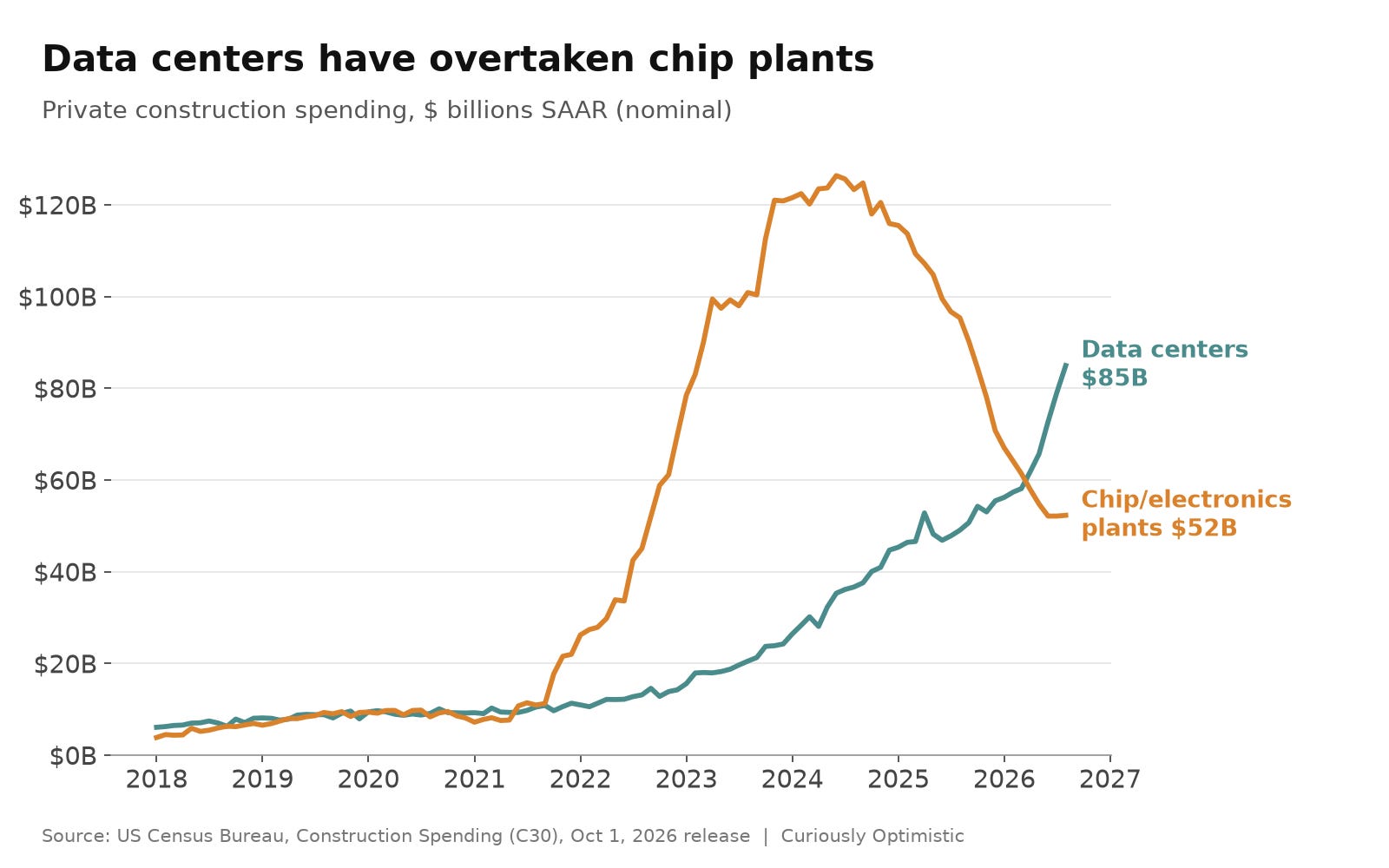
Nearly all of the decline sits in one line: computer, electronic and electrical plants. That’s the chip fabs and, by the Census definition, very likely the battery plants. The line peaked at $126 billion in June 2024. It was $52 billion in August. Take it out and everything else is up about 1%.
So reshoring didn’t stall across the board. The fab and battery wave crested, it’s rolling off, and nothing that size is starting behind it. The money went somewhere else. Data center construction hit $85 billion at an annual rate in August, up 73% in a year. In early 2018 it was about $6 billion.
Ten years, and output hasn’t moved
A step deeper, and it gets more uncomfortable. The Fed’s index of US manufacturing output was 99.2 in August 2016. It was 99.1 this August. A decade of tariffs, CHIPS, IRA and announcements, and we make about the same amount of stuff.
Manufacturing employment is 21,000 below January 2025, though it’s turned up for four straight months (BLS). The Reshoring Initiative, which tracks this better than anyone and is firmly on reshoring’s side, counted 244,000 announced jobs in 2025. Announcements and payrolls aren’t moving together.
Further, among manufacturers that reshored or are doing it now, the share satisfied with the results fell from 96% to 65% in a year (2026 USA Reshoring Survey). Those aren’t skeptics. Those are the people who did it.
That doesn’t mean the buildings were a waste. Capacity takes years to become output and plenty of those fabs aren’t running yet.
Chemistry had its boom a decade ago
Chemicals is the line people point to as the exception, and on the surface it is. Chemical construction was $43.7 billion at an annual rate in August, up about 6% from a year earlier, while most of what’s around it fell. It’s now about a quarter of all factory construction.
Adjust for what it costs to build and it looks different. The government’s price index for new industrial construction is up 74% since 2016. In today’s dollars, chemical construction ran about $66 billion a year in August 2016, at the tail of the shale cracker wave. It’s about $44 billion now. Back then chemicals was nearly half of all factory construction. We’re building about a third less chemistry than a decade ago, not more. (The index is for buildings, not process equipment, so call it rough.)
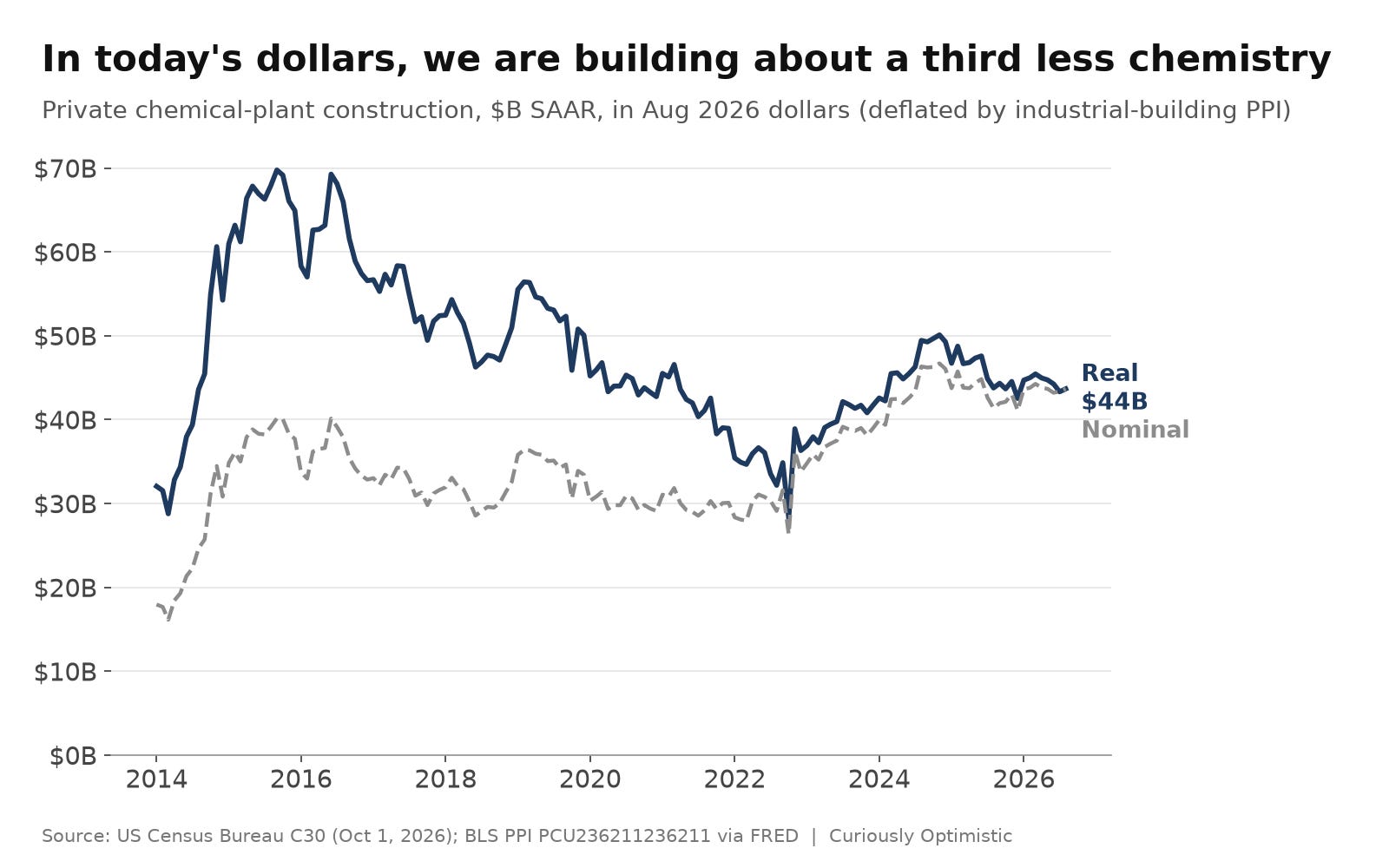
A fair objection: 2016 was a peak related to natural gas and energy. Against 2021 we’re up a little. Either way, chemistry never got a reshoring boom of its own (at least not yet).
Two numbers cut the other way. Chemical employment was 905,500 in September, up 11% since August 2016 on flat output (BLS via FRED), and that’s almost all pharma: ACC counts about 545,000 chemical workers outside pharma, and that number’s been easing (~5,500 works per year). And US chemical imports excluding pharma fell almost 10% in 2025, with the trade surplus still in place (ACC mid-year outlook). Neither one says we built the layer underneath. More people making the same output, mostly drugs, and fewer imports of chemicals we already make plenty of, isn’t reshoring. Drug imports tell you where the gap is: they’ve more than doubled since 2016 (UN Comtrade via Trading Economics).
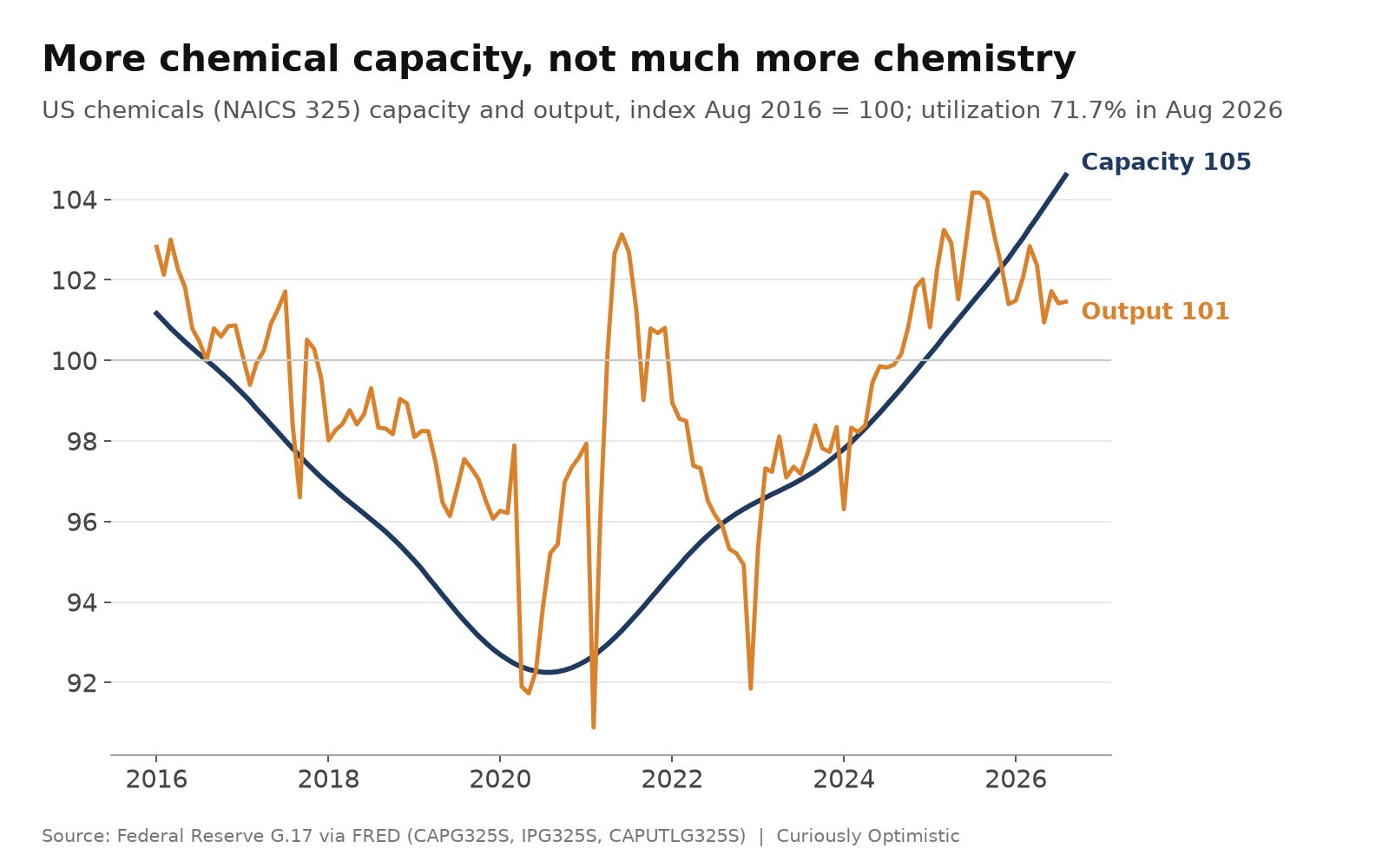
And the plants we already have aren’t full. US chemical capacity is up about 5% since 2016. Output is up about 1.5%. Utilization was 71.7% in August, the second-lowest reading in ten years (Fed G.17). The American Chemistry Council expects US chemical volumes to grow half a percent this year, with specialty chemicals down (ACC).
Open the box: it’s drugs and crackers
Then there’s what’s inside the number. The government’s definition of chemical manufacturing includes pharmaceutical plants, and the Census chemical line is classified the same way. So when Lilly breaks ground on a $6.5 billion API plant in Houston, as it did last month, it lands in the chemical bucket. So does the $8.5 billion ethylene cracker in Orange, Texas that’s commissioning now.
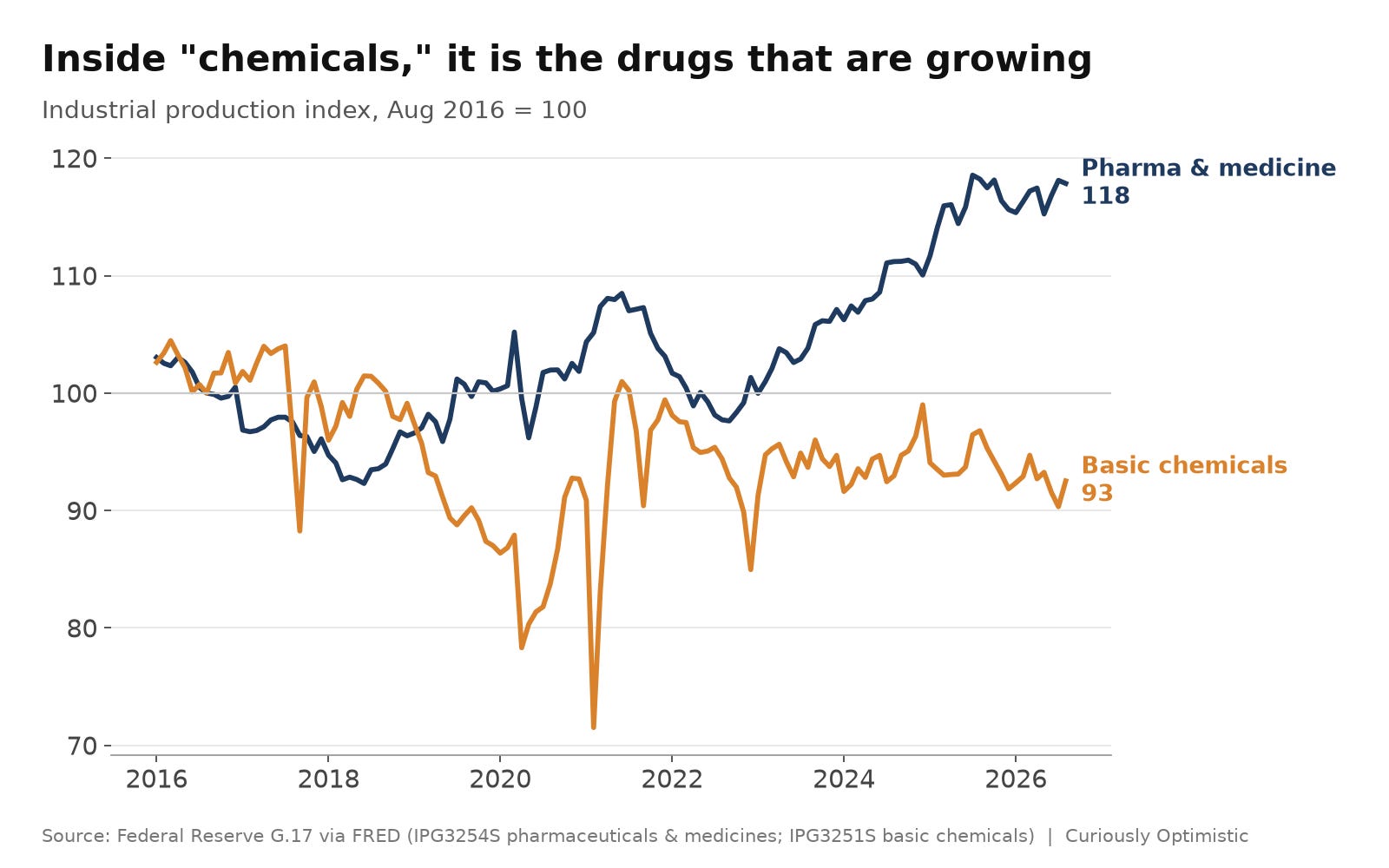
You can see it in output too. Since 2016, US pharmaceutical output is up 18%. Basic chemicals output is down 7.5% (Fed G.17). Inside “chemicals,” it’s the drugs that are growing.
When I added up the large US chemical-sector projects I could find with a dollar figure attached, drug plants were the majority of the money, then crackers, chlor-alkali and ammonia. Electronic-grade, specialty and explosives projects together came to about 5%. That’s my own tally, not an official number, and it leans toward big announcements. But it isn’t close.
The layer underneath isn’t getting built
This is the part I care about, because it’s where I spend my time.
Drug starting materials. USP found that 41% of the key starting materials behind US-approved drug ingredients come solely from China. Brookings put it plainly: making the active ingredient here doesn’t change the risk much if the starting material still comes from China. The new drug plants will need those inputs from roughly 2028 on. Very little of that capacity is being built here.
Fab chemistry. CHIPS put most of its materials money into wafers, polysilicon and substrates. The one award I can find for an actual wet chemical is a preliminary $52 million for ultra-high-purity isopropyl alcohol in Baytown, Texas. The fabs are being built. A lot of what they run on still doesn’t come from here.
Explosives. The Army awarded a TNT plant in Kentucky in November 2024, the first US TNT production since 1986. First output was supposed to come in about three years. The company now says early 2029.
I’m hearing the same thing from owners. In three separate conversations this fall with people running US specialty chemical businesses, the story was the same: reshoring talks started strong and died on price. US quotes came in 30% or more above Asia, and the customer decided to live with the risk.
Why it doesn’t get built
I don’t think it’s money. Finding the money is easy. It’s the demand side at the price point.
The world isn’t undersupplied. China and India make most of these molecules, they make them well, and they make them cheaper, often a lot cheaper. You just don’t like where it’s made. Asking a US plant to build redundant capacity at a higher cost isn’t really a capitalistic decision. It’s protection, or a backup plan, and somebody has to pay for it.
I can’t put a plant in the ground because you want it. I need an order: a price I can get a payback on, and a volume I can count on for five or ten years. A tariff alone usually doesn’t do it. Most buyers will eat the tariff and pass it along.
Washington hasn’t closed that gap. Everybody says the word reshoring, but it’s not specific enough. The policy hasn’t followed the value chain down to the precursor at step five, so nobody actually knows what they need. And the path of least resistance is to do nothing. I’d start by mapping the precursors under each critical drug, chip and munition, then pay for the order, not the building.
There’s a permitting piece too. In an August survey, SOCMA said 70% of the members it surveyed had cancelled projects because EPA’s new-chemical reviews take too long. That’s a trade group making its case. It matches what I hear.
What AI has to do with it
Apollo’s chief economist, Torsten Slok, made a macro case in the Daily Spark on October 9 (AI’s Insensitivity to Interest Rates Is a Problem for the Fed): the AI build-out doesn’t care about interest rates and soaks up capital, power and labor while rate-sensitive industries get squeezed. His conclusion: the Fed may have to hold rates higher for longer. Maybe. I’m not going to make a call on the Fed.
My read is narrower. Money for a good small chemical plant isn’t the constraint. What AI pulls on is everything else: grid connections, construction crews, attention. If you’re AI-adjacent, you’re growing. Everything else in industrial chemical land is still kind of languishing. It’s two extremes. And a small specialty project is competing for the same electricians and the same power as an $85 billion-a-year data center wave.
Where I think this goes
This part’s judgment, not data. I might be wrong.
Fewer new US plants starting up from 2028 on. Construction leads capacity by two to four years, and outside data centers and power the pipeline is shrinking.
Consolidation, not construction, in chemicals. Utilization near a ten-year low means more capacity than output. Expect rationalization, carve-outs, and buyers paying for plants that already run. Anupam Rasayan buying Jayhawk Fine Chemicals in Kansas this year is the pattern.
A starting-materials gap around 2028 to 2031, when the drug-plant wave comes online and needs inputs nobody built here. That’s an opening for qualified US plants, but only with an order behind it.
Data centers keep winning the fight for power and crews.
What I’d do differently Monday
If you’re underwriting in this space:
Don’t read chemical construction as demand for the specialty layer. It’s mostly large volume drugs and crackers.
A qualified, permitted, running US hard-chemistry plant is scarcer than the headlines suggest. It’s usually cheaper and faster to buy one than build one.
Underwrite reshoring revenue only when there’s an order behind it, a price and a volume for five or ten years. Without that, it’s a story, not a forecast.
Where I might be wrong
The counter-case is real. Sunlit opened a $100 million high-purity hydrofluoric acid plant in Phoenix in October 2024 to supply the fabs, in a chemical McKinsey says the US imports almost entirely from Asia. Manufacturing payrolls are up 72,000 from their December low. And the share of contract manufacturers quoting reshoring work doubled in a year, from 16% to 32% (2026 USA Reshoring Survey). If those plants run and the orders keep coming, I’ll have been early to the wrong side.
But most of that’s foreign-owned suppliers following their customers here, and none of it reaches the starting materials.
I’d like to be wrong about this. If you’re running a US chemical plant that got the order, or you’ve watched one die on price, I’d like to hear about it. Challenge me.
Sources: US Census Bureau, Construction Spending, October 1, 2026. Federal Reserve G.17 via FRED (IPMAN, IPG325S, IPG3254S, IPG3251S, CAPG325S, CAPUTLG325S). BLS Employment Situation, October 2, 2026, and PPI for new industrial building construction. Reshoring Initiative, April 6, 2026 release and 2026 USA Reshoring Survey. American Chemistry Council Mid-Year 2026 Outlook. USP Medicine Supply Map, June 2026. Brookings. NIST CHIPS awards. Spectrum News, October 5, 2026. SOCMA, August 13, 2026. ACC Year-End 2025 Outlook. UN Comtrade via Trading Economics. Apollo Daily Spark, October 9, 2026. Inflation adjustments use the BLS PPI for new industrial building construction and are approximate.