

Over Labor Day weekend 2026 I was at the Cleveland National Air Show on Burke Lakefront, and the F-22 Demo Team flew a full tactical demonstration. This wasn’t a polite flyby off in the distance. It was hard turns and steep climbs with the engine nozzles moving, close enough that you feel it in your chest. The Defense Visual Information Distribution Service (DVIDS), the military’s public photo and video archive, has footage of the team in Cleveland that week if you want to see it.
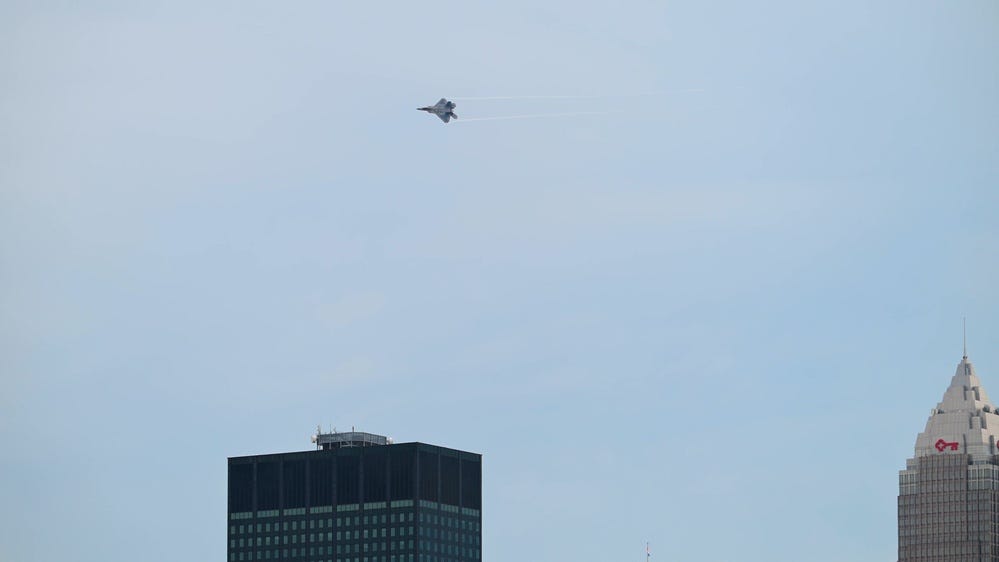
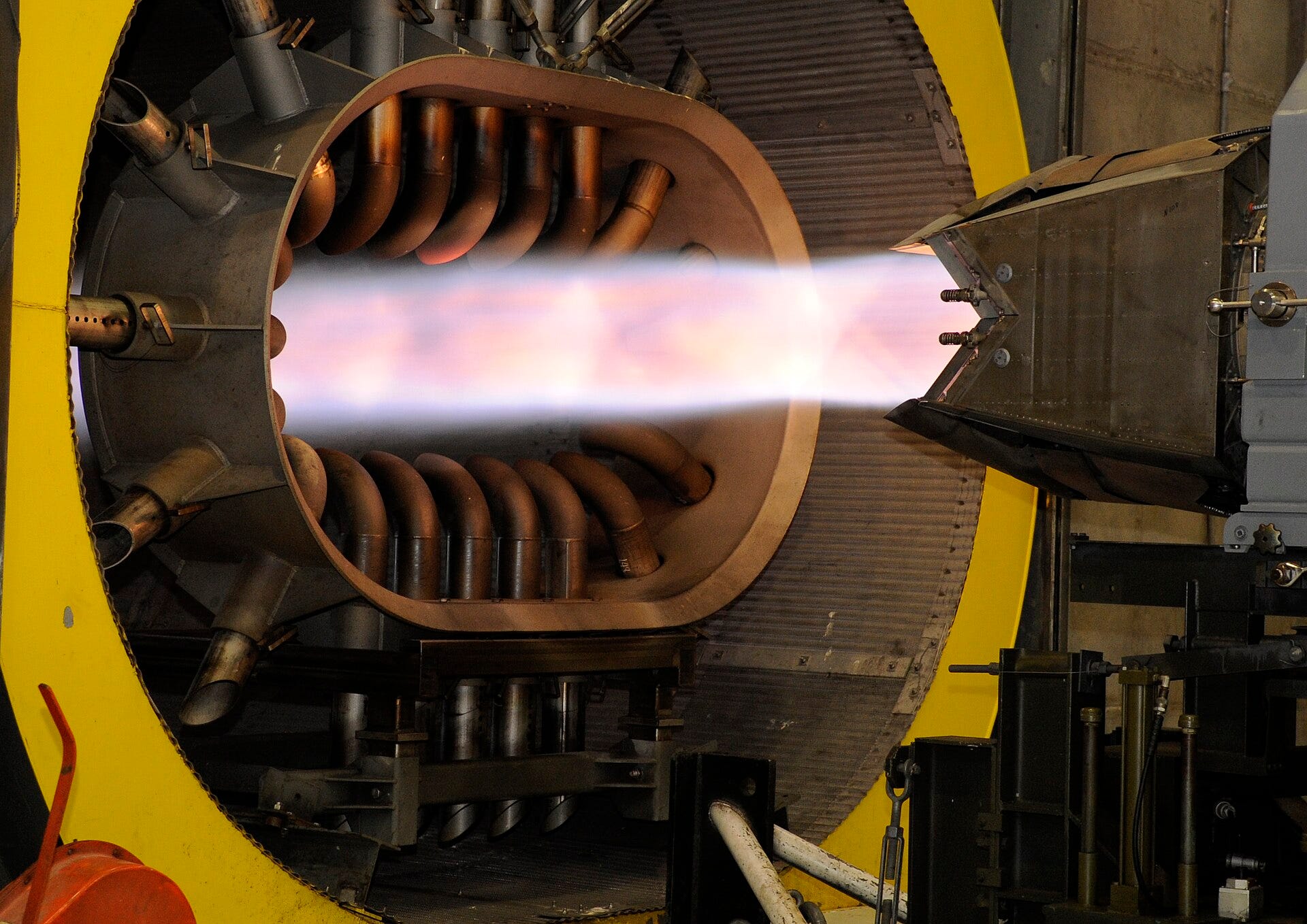
If you only know the Raptor from photos, here’s what you’re watching. The U.S. Air Force (USAF) fact sheet, which is the service’s official public description of the jet, says it can supercruise. That means it stays above Mach 1.5 without lighting the afterburners, the fuel-guzzling kick most fighters need to go that fast. It’s Mach 2 class when it wants more. It also has thrust vectoring. The engine nozzles tilt, so the nose can point and turn harder than a plane that only steers with its control surfaces. I’m not trying to rank every fighter on earth. I just wanted to know what I was looking at.
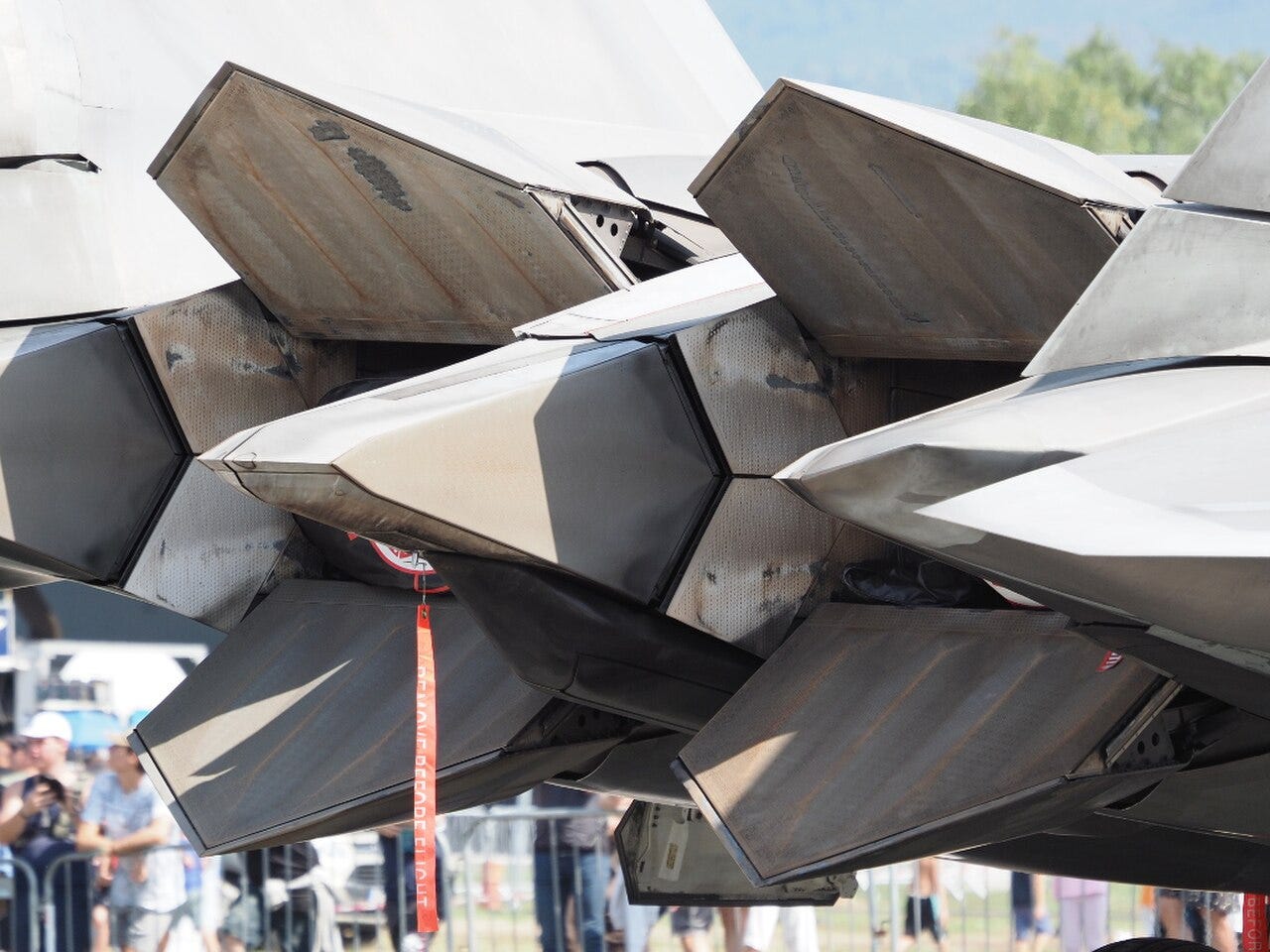
Sitting there, I got stuck on the question I always get stuck on when something that complicated looks easy. Who figured out the metal? Who made the resin? And how do you keep hundreds of small shops qualified long enough to build the thing, and then keep recoating it every time someone takes a panel off?
The names on the jet
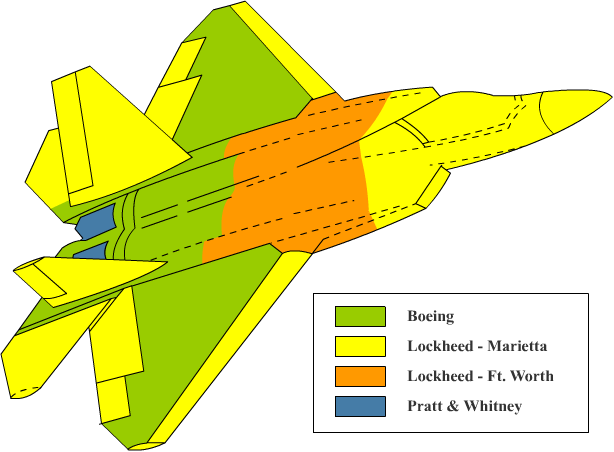
Lockheed Martin, Boeing, and Pratt & Whitney get the credit, and they earned a lot of it. Lockheed was the prime contractor. It did final assembly in Marietta, Georgia, and built the middle section of the fuselage in Fort Worth. Boeing built the wings and the aft fuselage. Pratt & Whitney built the F119, the engine that makes supercruise possible, under its own separate Air Force contract.
That’s the tip. Those three companies design the jet, put it together, and answer to the Air Force when something goes wrong. What they mostly don’t do is make every part.
How three companies turn into a thousand
This is the part I had to work through, because it isn’t obvious unless you’ve spent time around manufacturing.
A prime’s real job is integration. It owns the design, the drawings, the final assembly, and the flight testing. Then, part by part, it makes a make-or-buy call. Build this in-house, or buy it from someone who already does it well? On a fighter, a lot of things land on the buy side. The prime could probably learn to do most of them. But some smaller shop has already spent years getting good at one process and holding the certifications for it, and rebuilding that inside a giant company would cost more and take longer.
So the work flows down in tiers. A Tier-1 supplier sells directly to Lockheed, Boeing, or Pratt & Whitney. That might be a whole assembly, a wire harness, or a run of machined brackets. Tier-1 suppliers buy from Tier-2 shops, the forgers and casters and composite houses. Those buy from further down, from the mills, the resin makers, and the people who build the tooling. Each shop works from the drawing in front of it. Most of the shops below the prime never see the whole jet.
And it doesn’t stop at delivery. Sustainment, which is everything it takes to keep a delivered fleet flying, keeps pulling repairs, spare parts, and coatings work through the same kind of chain for as long as the jet flies.
That’s how three logos turn into roughly a thousand shops. The primes hold the program together, and the shops make most of the pieces.
How many shops are we talking about
The public numbers from original production are a little soft, and they don’t all count the same thing. Here’s where each one comes from.
In 2007, Boeing put out a press release celebrating the wing set for the 100th F-22. Almost in passing, it said parts and subsystems came from roughly a thousand suppliers in more than forty states.
In 2009, the Congressional Research Service (CRS), the nonpartisan research office that writes background reports for members of Congress, published a report on the F-22 program while Congress was arguing about whether to keep buying the jet. It cited a Lockheed map showing about 1,040 suppliers in forty-four states. A map like that is partly a lobbying tool, since it shows lawmakers how much of the work lands in their states. It’s still a real count.
Go back further, to 2002, and Lockheed was announcing its “Raptor of Distinction” award, which the F-22 industry team gave to standout subcontractors. That year it went to EDO, whose North Amityville plant was the largest single F-22 subcontractor in New York. The release said the jet drew on about 1,200 subcontractors and suppliers in forty-six states, including roughly forty New York firms, about thirty of them on Long Island.
The set I find most useful is the USAF F-22A Production Restart Assessment (2017). The Air Force wrote it for Congress to answer a question that kept coming up after the line shut down: what would it take to start building F-22s again? To answer that, it had to look back at how the original jets got built. It counts about a thousand first-tier supplier locations, roughly seven hundred Tier-1 firms, something like ninety thousand unique parts across the air vehicle and the F119 engine, and about forty thousand tools at the major fabrication and assembly sites.
The counts differ because one counts locations, one counts firms, and one counts every subcontractor and supplier the company could name. They all land around a thousand, which is what I trust. The parts number is the one that explains the rest. When I try to picture ninety thousand different parts, I end up picturing thousands of tiny product lines, each with its own drawing and its own tooling. Nobody runs all of that under one roof.
One line in that assessment stuck with me. Before any restart, the Air Force would have to confirm that the sub-vendors were still willing to do the work and could still requalify. Today’s sustainment base is smaller and different from the production-era count, but it’s still a multi-tier specialty chain, and it lives with the same question. Can this shop still make the part the drawing calls for, to the same standard, years later? In this world, that’s what reliable means.
Small batches, not a car plant
Most of those shops were never Lockheed, Boeing, or Pratt & Whitney. They were high-mix, low-volume places, a lot of them owner-operated. A car plant wins by making the same bracket a million times. These shops make short runs of odd parts that have to pass a qualification packet, meaning the shop has proven with paperwork and test pieces that its process makes the part to spec. Then they have to keep passing it. Change the process and you may have to prove it all over again.
That’s also why the chain gets so wide. One shop knows a difficult alloy. Another knows one weld process, or one sealant family, or one kind of tooling. The titanium shops aren’t the composite shops, the composite shops aren’t the adhesives shops, and none of them are the people running coatings robots, because each of those needs its own equipment, its own quals, and its own people who’ve done it for years.
A few of these shops show up by name in Lockheed’s small-business supplier releases, which is about the only public credit they get. In Texas, Complete Technical Representation in Carrollton and InterConnect Wiring in Fort Worth did machined components and wire harness kits, and M2 Global is in San Antonio. McGinty Machine in Wichita did precision-machined F-22 parts, according to a Lockheed release reposted on Airframer, a trade site that tracks aircraft suppliers. Click Bond, in Carson City, Nevada, makes fasteners. And Fort Walton Machining on the Florida Panhandle started with two people in 1997, grew into a serious qualified shop, and was named Lockheed’s 2010 Small Business of the Year.
Most of the thousand never got a press release at all. To see what they actually do, it helps to follow the materials.
Titanium that had to get qualified
Materials tables published while the jet was being built, including in the materials-engineering trade press, put titanium at somewhere around two-fifths of the structural weight. That’s more than nine thousand pounds in the airframe, roughly the curb weight of three mid-size cars, in just that one metal.
Ti-6-22-22 is a high-strength titanium alloy that the F-22 was the first to use at scale. The name is shorthand for its recipe. It isn’t commodity bar stock, and it had to be qualified for this jet.
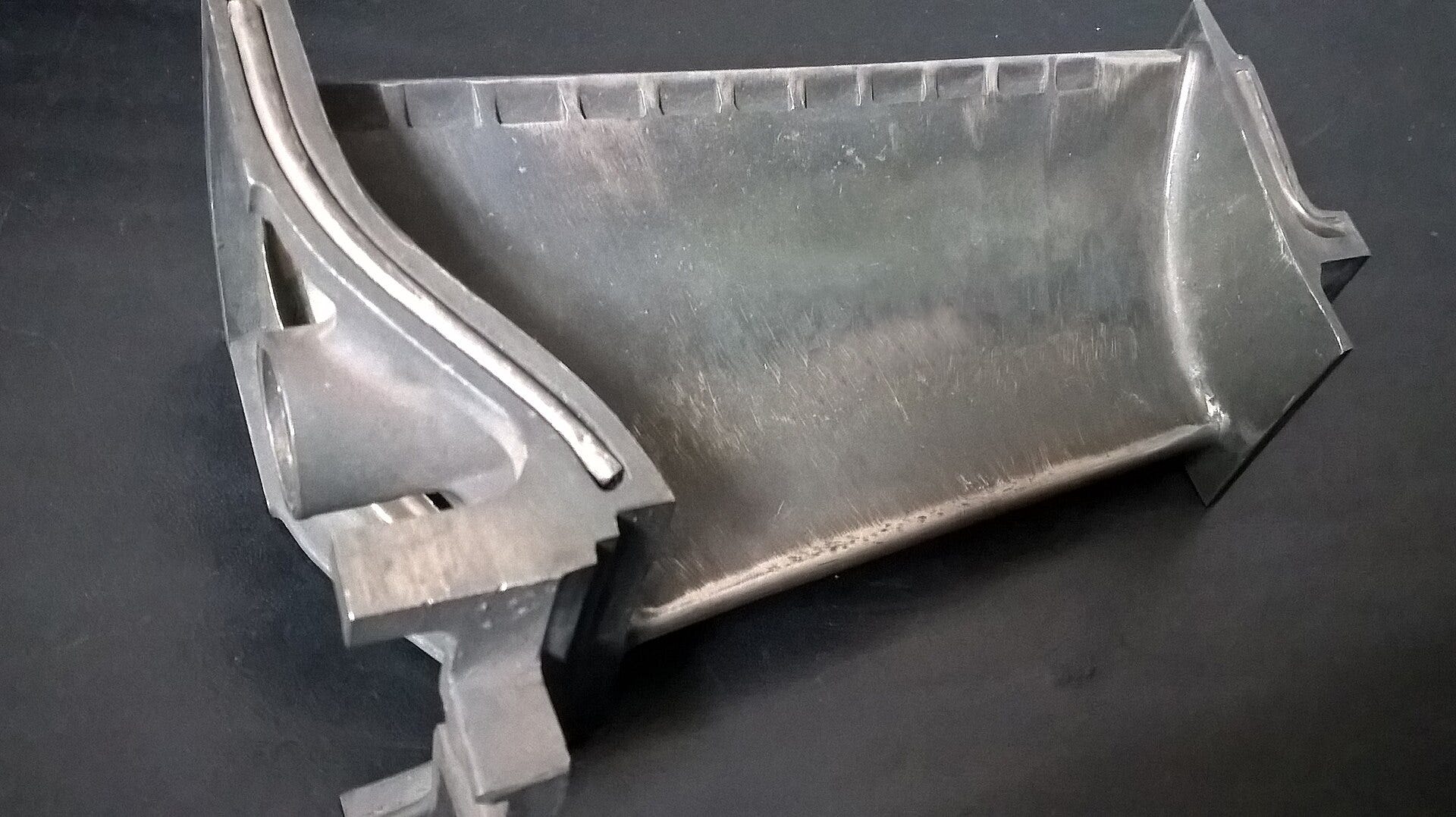
Then there’s how you process it. Hot isostatic pressing (HIP) takes a rough titanium casting and squeezes it evenly from every side, at north of ten thousand pounds per square inch, to close up the tiny voids inside. Published accounts of the program name big pieces like rudder actuator housings, canopy decks, and inlet frames. Electron-beam welding joins thick titanium aft assemblies inside a vacuum, so oxygen can’t make the metal brittle. The payoff is that you can get rid of something like three out of four fasteners in those joints. Fewer holes means less weight and fewer places for things to leak or crack.
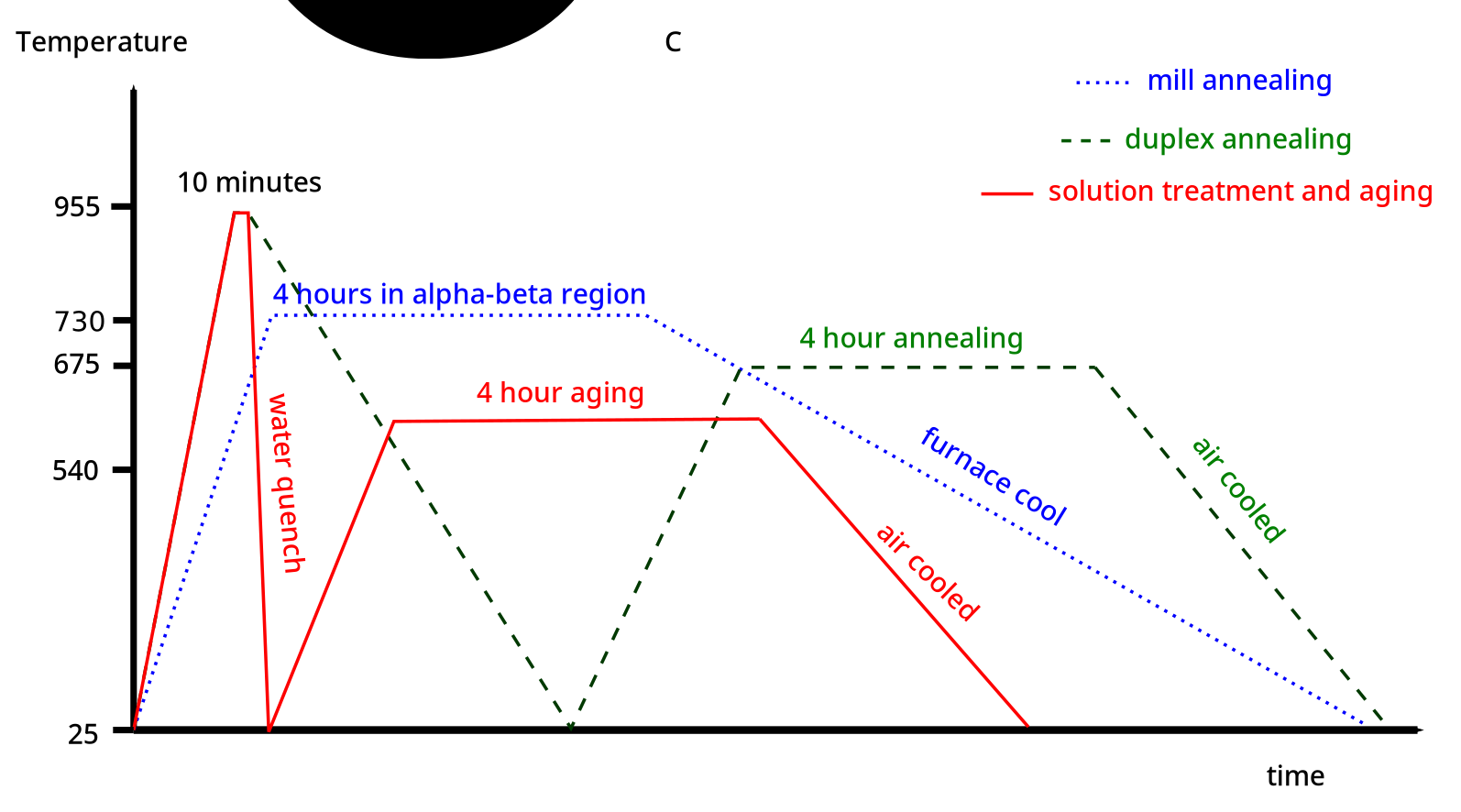
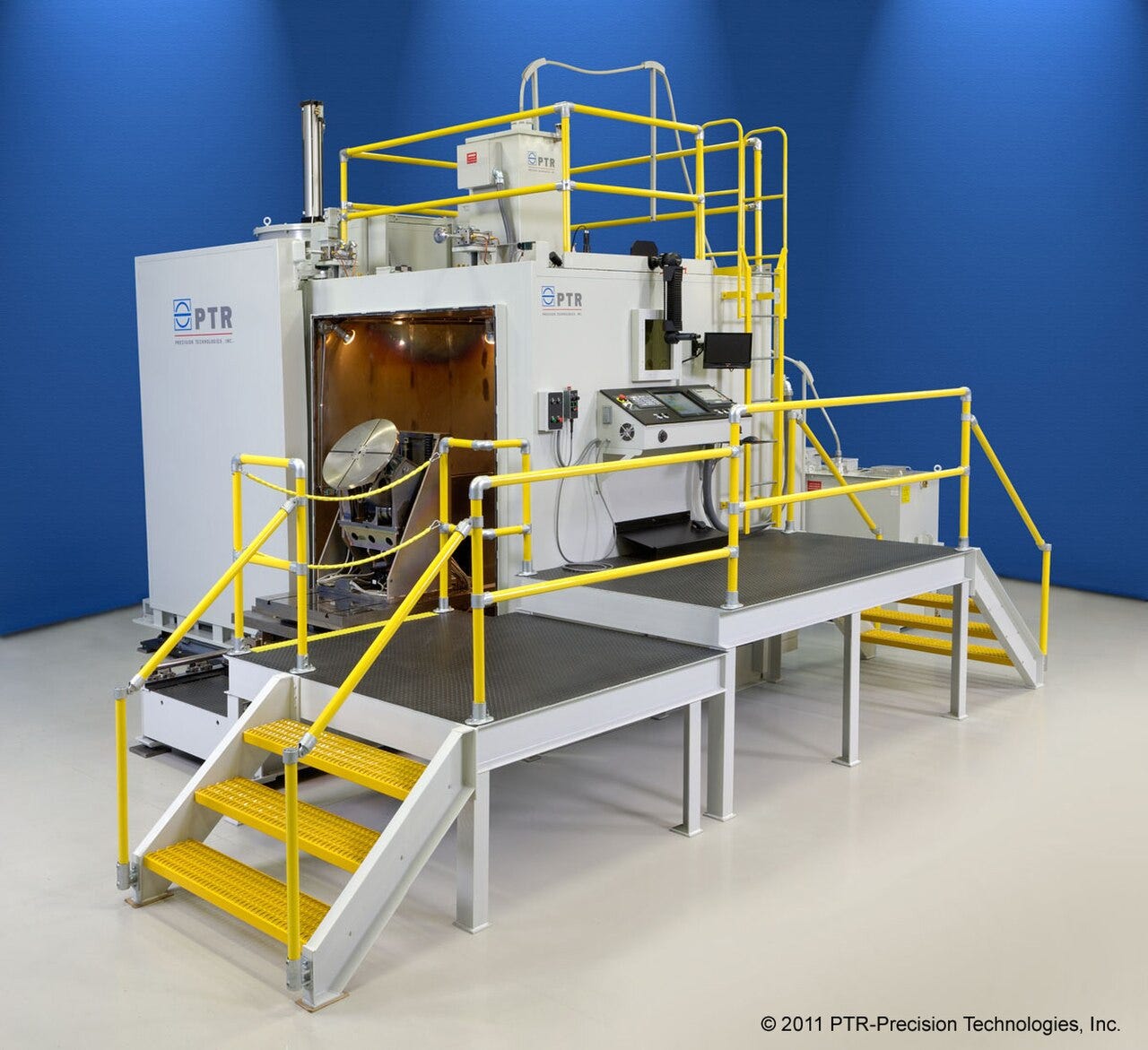
None of that is a prime pouring some metal. It’s mill work, casting control, vacuum welding, and tooling, mostly in shops you’ve never heard of, and they have to stay good at it.
Why the skins are BMI, not “plastic”
When people hear “composite” they tend to picture fiberglass on a boat. That’s the wrong temperature range entirely.
The exterior skins are bismaleimide (BMI), a resin that cures hard and holds up at temperatures where ordinary epoxy starts to soften. That matters at supercruise, when the skin heats up at speed. The best public source I’ve found is a CompositesWorld article on high-temperature resins. CompositesWorld is a trade magazine for the composites industry, and that piece walks through which resins were built for heat and where they ended up. For the F-22, it names Cytec’s BMI. The skins use IM7/5250-4 prepreg, which is IM7-grade carbon fiber that arrives already soaked in 5250-4 BMI resin. And Cytec’s CYCOM 5250-4 resin went into nearly four hundred components made by resin transfer molding.
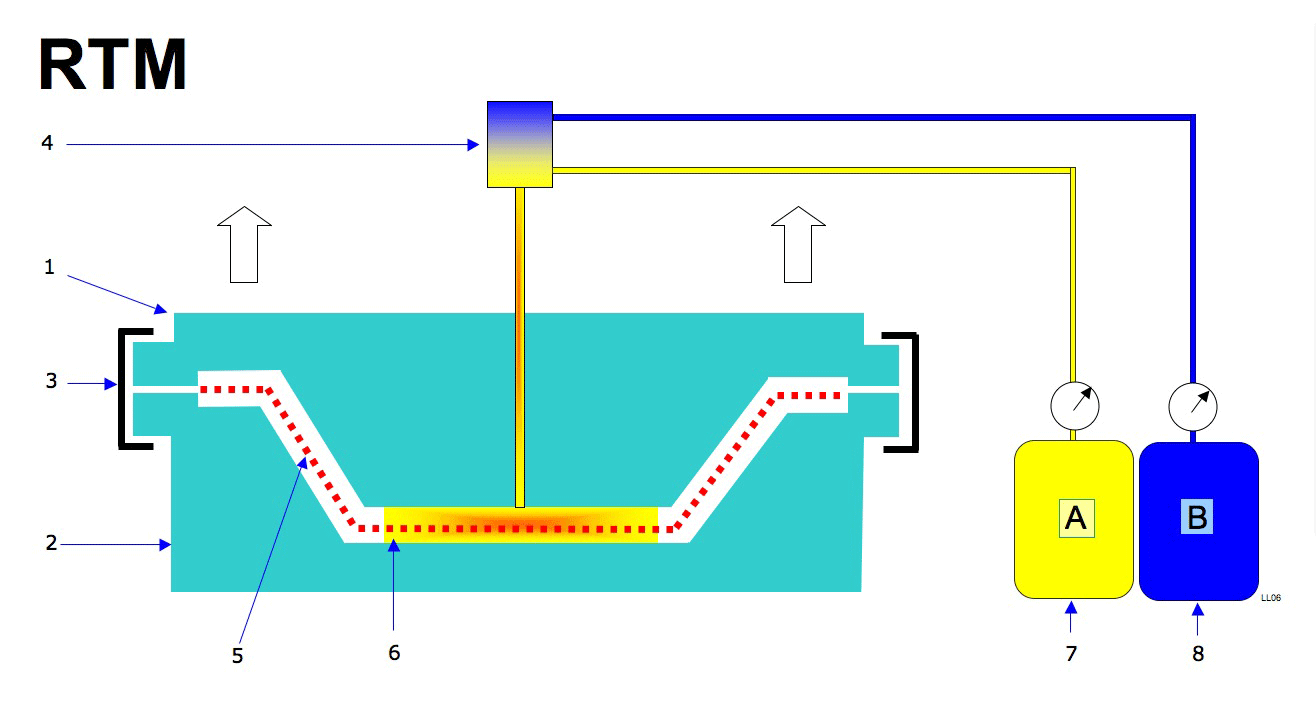
Resin transfer molding (RTM) works like this. You put dry carbon fiber into matched metal tooling, inject heated resin under pressure, and cure it tight. That’s nearly four hundred molded parts, every one of them held to fighter-jet tolerances, and every one needing tooling that somebody had to build.
That Cytec line was in Tempe, Arizona, back then. Ownership changed later. Cytec went into Solvay, and the specialty materials business now sits under Syensqo, so today it’s a Belgian-parent specialty chemical company with a US plant lineage. That’s common in specialty chemicals. What I like about it, and what I’d want a kid who’s into how things are made to know, is that the resin has a name, a process, a plant history, and a qualification trail behind it.
Every panel open is a coatings job
The metal and the resin get the jet built. Keeping it flying is a different job, and a lot of that job is coatings.
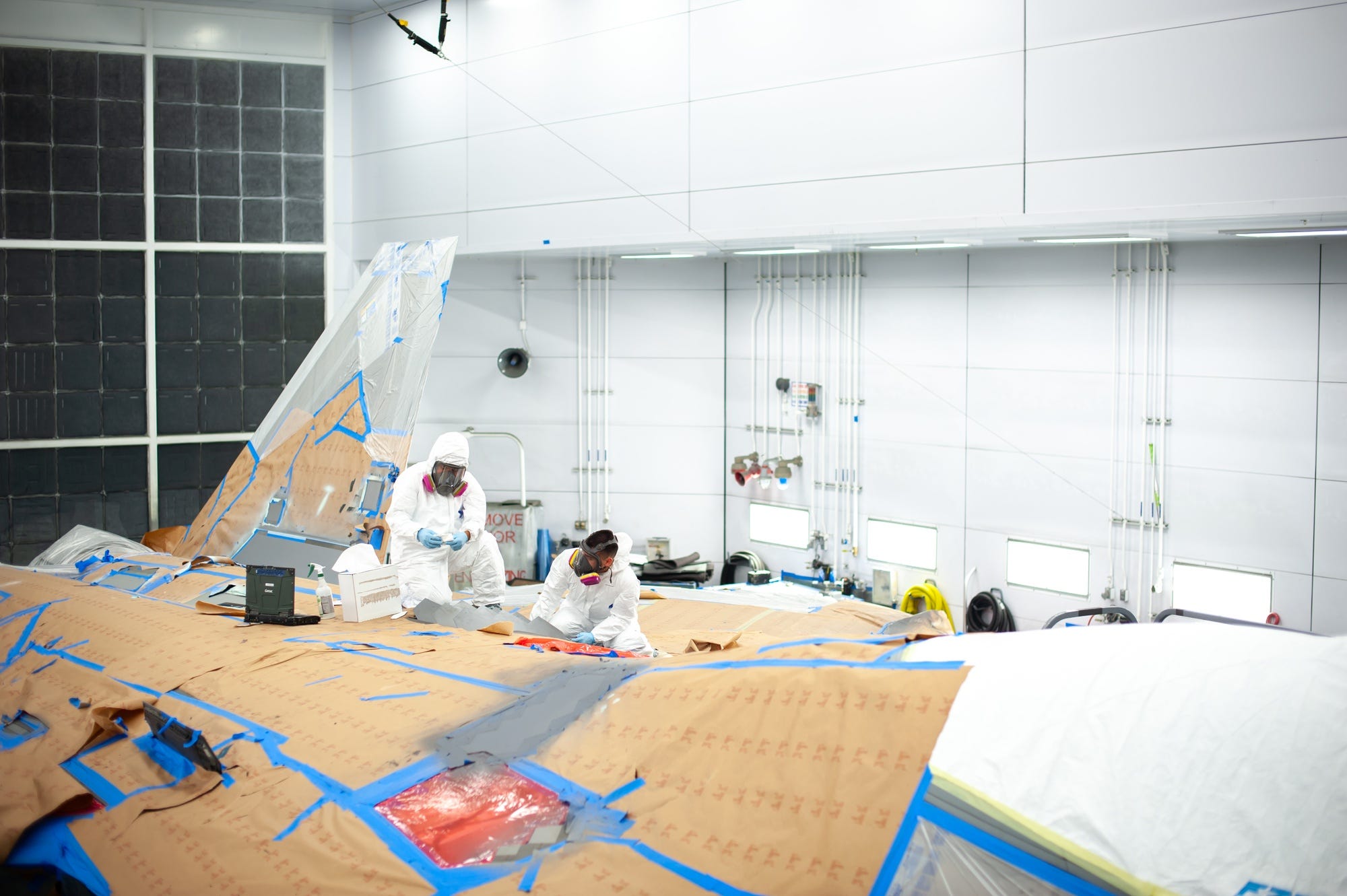
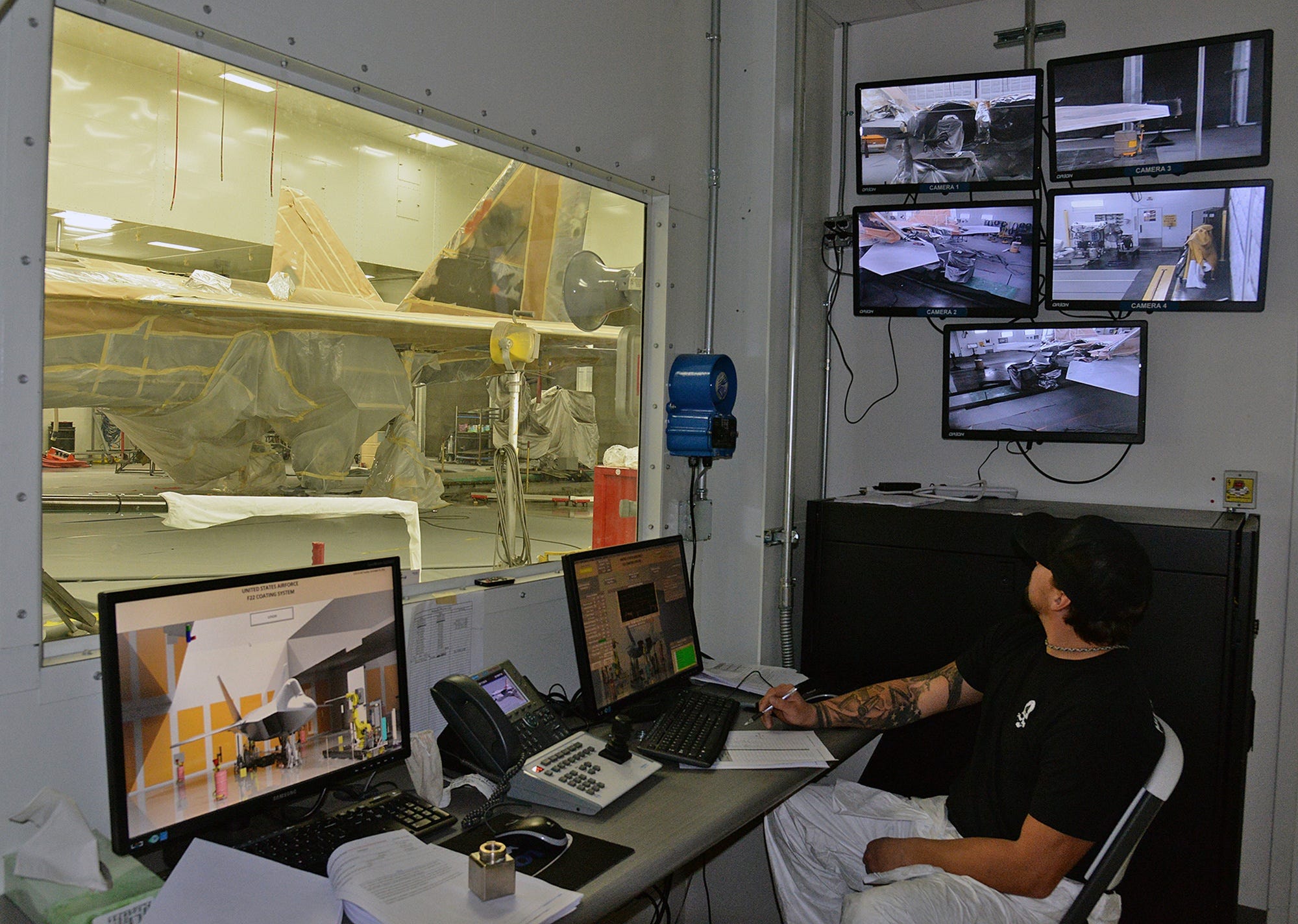
The F-22’s stealth comes from low observables (LO), the features that make it hard to pick up on radar and infrared sensors. Shaping comes first: aligned edges, canted tails, inlets that snake so radar can’t see straight into the engine, and weapons carried inside. On top of that sits a multi-layer coating stack you can describe without giving away any recipes. There’s a primer, conductive layers, radar-absorbing material (RAM), gap fillers, and an infrared-reducing topcoat. Lockheed names a couple of fixes it’s working on to cut down on coating damage, Mighty Tough Boot and Form In Place. The companies that formulate the coatings aren’t named.
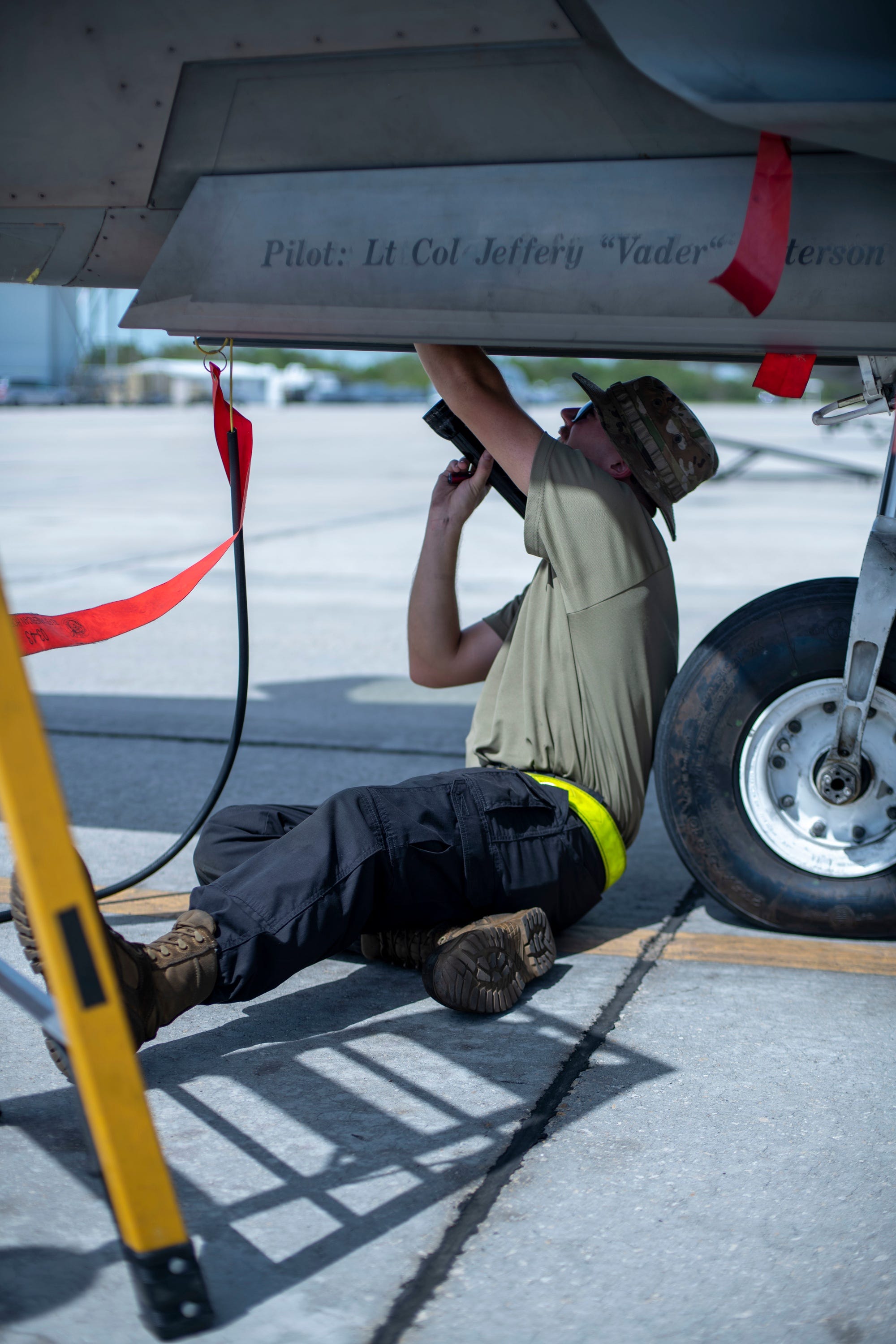
Lockheed’s F-22 sustainment page is where Lockheed describes the support work it does for the fleet, so read it as the company describing its own business. It says roughly half the maintenance on the jet is fixing stealth coatings that get damaged whenever a panel is opened for routine work. I’d have guessed engines, or avionics. So every time a panel comes off, somebody has a coatings job to do afterward.
This is also where a small company can matter without owning the chemistry. The Small Business Innovation Research (SBIR) program is how federal agencies pay small companies to solve specific problems. Through it, Aerobotix, a robotics firm in Madison, Alabama, won Air Force work to build multi-axis robots that reach deep into F-22 engine inlets and restore the specialized coatings at the depot, the Air Force’s heavy-maintenance base at Hill Air Force Base in Utah. The Air Force wrote up the project in 2017. Before robots, picture a maintainer in a Tyvek suit crawling up a twisting duct to do it by hand.
What we can say is American
The primes and final assembly are American, and the jet itself is US-only, since export is prohibited. Specialty metals fall under a domestic-preference rule in defense contracting, so titanium and specialty steels are generally melted or produced in the US or a qualifying country. That’s a rule about preference, though. It isn’t a map showing where every billet was melted. The BMI has a US plant lineage inside a global specialty-chemical parent. The LO coating formulators are opaque in the public record. And there are named US shops doing the application work.
So the honest answer is mostly American, with a few parts I can’t see into, and I’d rather say that than pretend I know more.
Strip the logos
If you took Lockheed, Boeing, and Pratt & Whitney off the top, what would be left?
Mills, HIP casters, electron-beam weld shops, BMI resin lines, RTM tooling houses, sealant makers, coatings floors. In the production-era count, that’s about a thousand first-tier shops across more than forty states, all making short runs of odd parts that had to stay qualified. I think that’s what people actually mean, or should mean, when they say “fighter industrial base.” I was thinking about all of them while the Demo Team came back around over Lake Erie.
I might be wrong about parts of this map. If you’ve worked in one of these shops, or you know where I’ve got it off, reply and tell me. And if you want the next one, subscribe to Curiously Optimistic.