

I’ve totally messed this up. More than once I over-engineered the answer. We’d talk about material science and a differentiated technical solution when, in fact, what the customer was buying was reliable manufacturing. The work that needed doing was driving down cost to serve, and getting better at speed, communication, relationships, and capacity. A wrong read on value sends the plan, and the spend, after the wrong thing.
In my last post I wrote about Vikas Mittal’s argument, on HBR IdeaCast, that customers can tell you what they want but often can’t tell you what they value, and April Dunford’s point that you’re often losing to the status quo. In chemicals and materials, the status quo has something extra going for it. It’s already qualified.
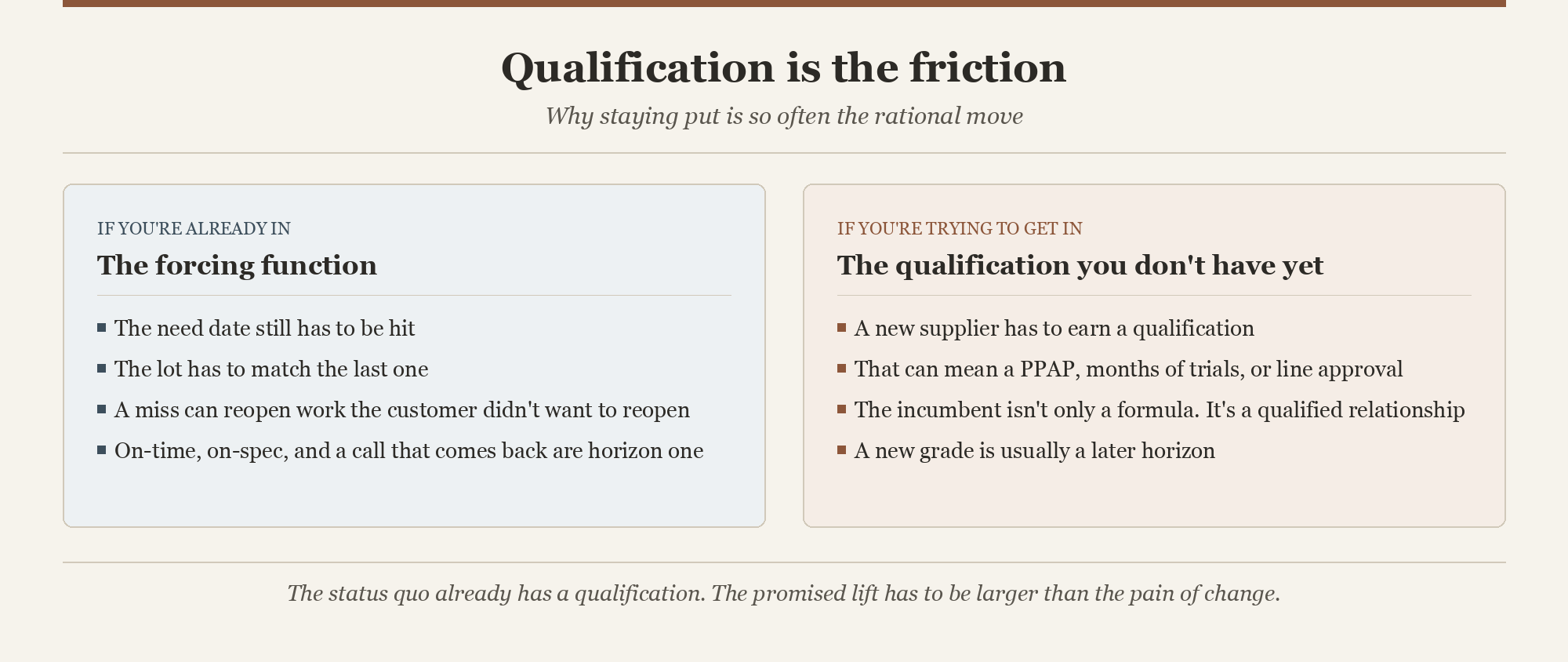
If you’re the incumbent, the forcing function is the need date and the lot that has to match the last one. If you’re trying to displace someone, the friction is the qualification you haven’t gotten yet.
Delivery and technical support moved up the list
In August 2025, Accenture published its 2025 Global Chemical Buyer Value Study. It’s based on 2,500 respondents across 12 countries and the chemical value chain. They write that “while product performance remains crucial, reliable delivery and quality technical support have become more important than easy access to product information and product innovation.” Product performance still matters. What drops down the list is novelty.
If needs are met, 43% of customers said they were willing to buy at least 10% more, and 36% were willing to pay a premium of 5% or more. Since 2020, the number of customer needs that chemical companies underestimate has more than doubled, from 7 to 16. Accenture’s 2020 Global Buyer Values Study for Chemicals, fielded in March and April 2020 with over 2,000 participants, including 760 industrial buyers, had already found that sellers “significantly underestimate the importance that consistent, on-time delivery has for buyers.” Accenture called it by far the largest gap in seller-buyer perceptions on supply chain. Reliability, the authors said, means on time in full, not merely fast, and “buyers want sellers to get the basics of reliable delivery right in the first place, rather than mitigate problems after the fact.”
A new grade is easy to talk about. A need date is routine, until you miss it.
Satisfaction is weakest where it matters
The AMCX Consortium’s 2024 survey results, published by Dow in 2025, covered 16 large B2B companies, including 9 chemical manufacturers and 3 chemical distributors, and more than 7,200 customer responses. The three factors rated most important were trust in the supplier, product and solution quality, and order delivery reliability. Innovation wasn’t one of the needs surveyed. The lowest satisfaction scores across all sectors included order delivery reliability and service and support handling. Delivery reliability made both lists: top three on importance, among the lowest on satisfaction. That’s a planning problem.
A public company has already said it plainly
On 3M’s third-quarter 2024 earnings call, on October 22, CEO Bill Brown put it in operating language. “I know we’ve lost business and have paid fines due to poor delivery performance,” he said, “and I’m encouraged by the steady improvement we’re making, ending Q3 at 89% OTIF, up five points since the beginning of the year and 10 points above Q4 of 2022.” Later on the same call: “we are losing business if we’re not delivering it on time and full to customers. We know it. We see it every single day.” Miss the need date, and the customer doesn’t have to prefer a rival’s new grade. They just have to stop trusting the incumbent.
New grades fail more often than the planning slide implies
If novelty were the reliable path, I’d expect new-product programs to land more often than they do. In May 2013, McKinsey wrote about chemical innovation using interviews with 20 R&D leaders at 10 major US chemical companies. They defined success as a project that created a positive return at the innovator’s cost of capital. When the company was familiar with both the market and the technology, typical success rates were 40 to 50%, usually product extensions. When both were unfamiliar, typical success rates were 15 to 20%, and commercialization could take 8 to 19 years. The key driver of that low success rate, McKinsey said, was “failure to understand the needs of the market.” Most interviewees said their companies spent 40 to 50% of R&D on the familiar-familiar work. “We’ll launch a new grade” is a hypothesis with a failure rate attached. McKinsey’s own conclusion was that innovation still creates value overall.
Qualification is why the status quo is hard to move
There’s no clean public number for what a late or off-spec delivery costs. You can see the cost in customer requirements, though. This is also Dunford’s “pain of change,” sitting in a plant instead of a software migration.
In automotive supply chains, supplier changes after approval need the customer’s okay in advance, and can trigger a PPAP resubmission. Supplier quality manuals are explicit that quality, packaging, or on-time failures can be charged back, including the downtime those failures cause. Autoneum’s 2023 supplier quality manual is one public example. In electronic materials, qualifying a new process chemical typically takes months of lab work, wafer trials and fab approval. Once you’re in, a miss is more than a missed truck. It gives the customer a reason to reopen a qualification they didn’t want to reopen.

That’s why “no decision” here often isn’t indecision in the sales-software sense. It’s a customer concluding that the pain of change, the requalification, the risk of an off-spec lot, is larger than the promised lift from a new grade. The status quo already has a qualification. A new supplier has to earn one.
I said a version of this in the Custom Chemistry Makers Field Guide (paid post), and I still think it’s right. The capability and the qualified customer earn the premium, not the reactors. A qualified customer, I wrote, is one a buyer can’t rebuild in a year.
So in a chemicals planning meeting, I try to keep horizon one on what the customer already pays for: the need date, the lot that matches the last one, the technical support that comes back. A new grade is usually a later horizon. That’s McKinsey’s three horizons, from Mehrdad Baghai, Steve Coley, and David White in The Alchemy of Growth (1999), later restated in a short Enduring Ideas recap (2009). Horizon one, in how I use it, is what I should do right now. It separates working in the business from working on the business. That’s my language, not a sentence from the book. Their point is that you manage all three at once, so the core keeps paying the bills while you build what’s next. It keeps the room from treating a someday aspiration as this quarter’s work.
Underwriting works the same way. In this industry, switching usually means reopening a qualification. If the story is only a differentiated molecule, and the job is to be a reliable manufacturer, I’ve seen how far that can pull priorities off course.
The surveys could be over-weighting what people say in a questionnaire. McKinsey’s launch numbers are old. I honestly don’t know how far this runs from specialties into commodities, or the other way. If you’ve got a case that cuts the other direction, I’d love to hear about it.